Variations / COS / CU-CONT-002 / V1.0
A Variation Is Not Just Extra Work: How to Establish a Contractual Variation
Extra work is a factual description. Variation entitlement is a contractual position.
A revised drawing reaches site. The quantities increase. The work is executed, measured and included in the next variation statement.
The submission says: “Additional work carried out as instructed.”
That establishes part of the history. It does not yet explain what changed contractually, who could require that change, or how the claimed adjustment follows from the Contract.
The work may have been additional, difficult and expensive. It may also have been necessary to fulfil an obligation the Contractor had already accepted.
Before pricing a construction variation, establish the obligation that changed.
1. Start With the Original Obligation
Before asking “How much extra work did we do?”, ask: “What was the Contractor already obliged to do?”
Read the scope alongside the contractual drawings, specifications, BOQ or payment schedules, incorporated clarifications and amendments. Establish the design responsibility and contractual risk allocation. Where documents conflict, apply the Contract’s hierarchy or priority provisions rather than selecting the document that supports the preferred answer.
The BOQ matters. Its function matters too. A schedule used for milestone payments does not necessarily operate as a remeasurement BOQ. The absence of a separate priced item does not, by itself, establish that the work falls outside an EPC obligation.
A tender estimate is also not the same thing as the contractual scope. If the Contractor allowed for one quantity but a compliant design requires more, the difference needs examination against the design and quantity risk it accepted. Conversely, a lump-sum price does not settle the treatment of a demonstrable Employer change.
Identify the baseline precisely: the relevant document, revision, requirement, location and responsible party. Distinguish binding requirements from reference information and assumptions that were never incorporated into the agreement.
That is the starting point for an extra work claim. A cost overrun is not a substitute for it.
2. Identify the Change in Obligation
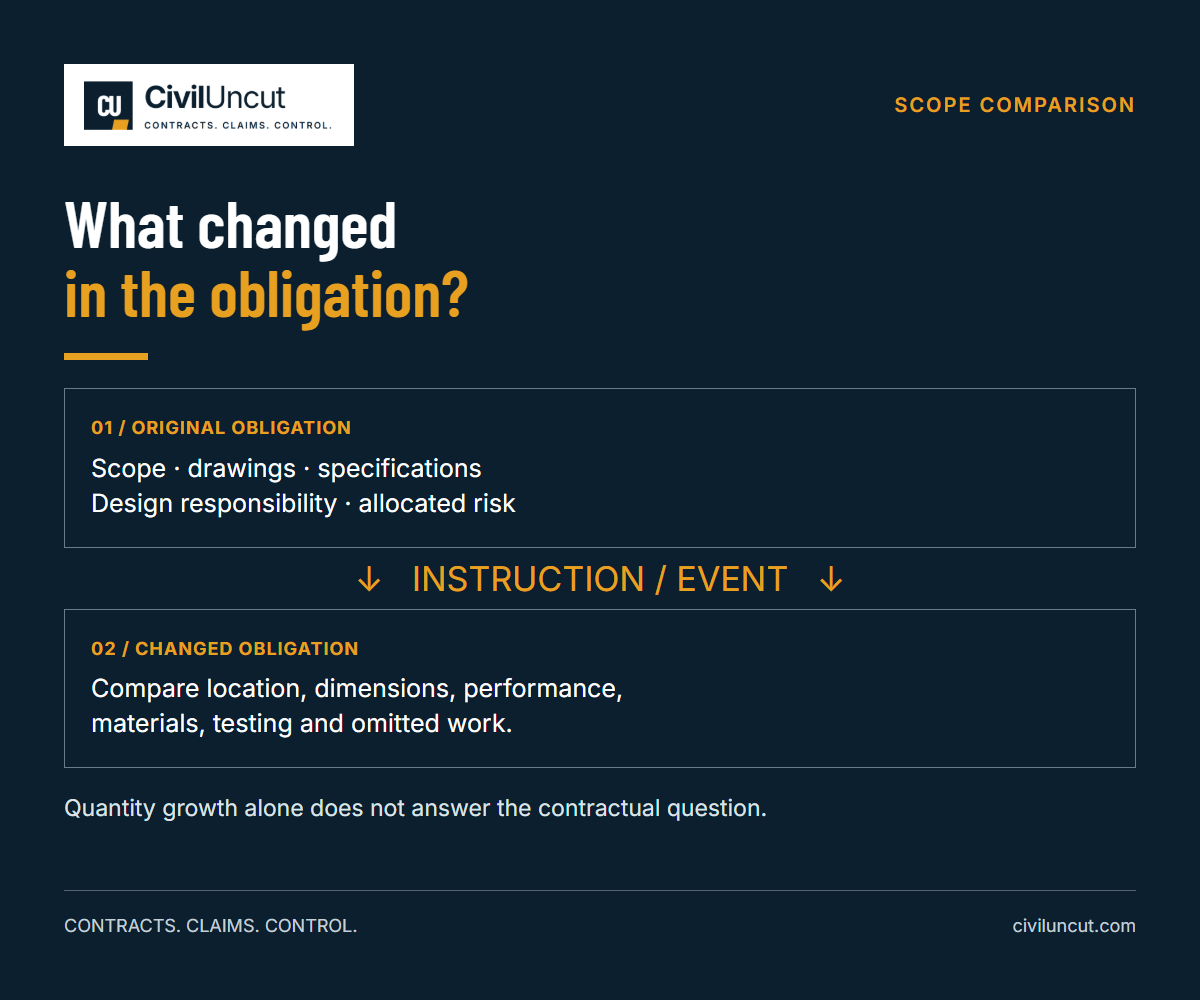
“Drawing revised” is an event. The scope comparison must explain what the revision required the Contractor to do differently.
Compare the original and revised requirements by location, dimensions, materials, performance, testing and interfaces. Include work removed or replaced. Keep the superseded drawing and the instruction that introduced the revision, with issue and receipt dates.
Consider a revised drawing that increases the concrete quantity in a structure. Was the structure enlarged to meet a new Employer requirement? Did the Contractor develop its own design to satisfy unchanged requirements? Was an error being corrected? Or does the Contract simply pay the actual measured quantity under an existing item?
The physical result may look similar in all four cases. The contractual analysis differs.
A useful comparison would identify the original geometry and governing requirement, the revised geometry, the reason for the revision and the instruction reference. It would then isolate the incremental quantity. “Concrete increased” leaves those questions unanswered.
Quantity entitlement and rate adjustment are also separate. Additional measured quantity may be payable under a remeasurement mechanism without establishing a separate change of scope or a right to a new rate.
The terminology should follow the Contract. Additional work describes activity. A Variation or defined Change of Scope describes a contractual mechanism. Design changes, specification changes and omissions may fall within that mechanism, but their labels do not decide the result. An instruction may only enforce an existing requirement.
3. Establish the Cause Before Presenting the Consequence
The change file should connect the cause, instruction or event, changed obligation and resulting impact.
Take a foundation revised from a shallow footing to piles. The comparison needs more than the two drawings and a piling invoice. What caused the revision? Was the original design compliant? What did the Contract say about investigation, reliance on ground information and design responsibility? Did the Employer introduce a new requirement, or did the Contractor have to correct its own design?
Keep the technical explanation and the contractual allocation beside each other. A sound engineering reason for piling does not, by itself, identify who bears the cost.
The valuation then needs to address the omitted footing as well as the piles, mobilisation and testing. Any abortive work needs its own factual and contractual support. The programme assessment needs the redesign, approval, procurement and construction consequences.
The causal chain is therefore more specific than “foundation changed, cost increased”. It identifies why the requirement changed, the route under the Contract and the consequences attributable to that change.
4. Who Had Authority to Instruct It?
Identify the person who gave the direction and the power under which it was given. An Engineer, Authority’s Engineer, Employer representative or site representative may have different functions under the particular Contract.
The power to review a design, request a proposal, direct technical compliance, order a change, approve a rate and certify payment should not be assumed to be interchangeable. Check delegated authority, its limits and any requirement for further consent.
An additional roadside drain illustrates the problem. A site representative asks for it. Before treating that request as a payable Variation, establish whether the drain was already required by the drainage scope or performance criteria. If it changes that obligation, establish whether the representative could order the change or whether an Authority or Employer decision was required.
The historical NHAI EPC examples in the research distinguish the change-notice process involving the Authority’s Engineer from the Authority’s Change of Scope Order. They illustrate why the actual procedure matters; they are not a rule for every highway agreement. FIDIC’s institutional guidance likewise points to the relevant procedures and limits on the Engineer’s authority. Use the executed form and amendments on the project.
Where the parties disagree, set out the original requirement, the alleged change and the decision requested. Examine the Contract’s duty to proceed, objection provisions and dispute procedure. Neither a blanket refusal nor an assumption that every site direction is binding is a reliable general approach.
5. A Verbal Instruction Needs an Accurate Record
A retaining wall is being constructed. During a site visit, a representative directs the team to increase its height. The Contractor proceeds, and formal confirmation is still pending when the extra quantity is billed.
The questions are practical: who gave the direction, what exactly was required, when was it given, and who witnessed it? What was the original level? Did the person have the necessary authority? What does the Contract require for written instructions or confirmation of oral directions?
Record the direction promptly and seek confirmation through the prescribed route. Preserve the correspondence, site diary, photographs, drawing revisions and relevant meeting minutes. Record any response or disagreement accurately.
A later confirmation may be important evidence. An unanswered email from the Contractor is not automatically an authorised Variation. Any contractual mechanism for confirming oral instructions must be checked for its wording, recipient, timing and effect.
Do not backdate a record to make the sequence look complete. A file that distinguishes the oral direction, execution and subsequent correspondence is more useful than one that conceals the gap.
6. Follow the Procedure While the Change Develops
Notice and record preservation start when the event arises. They should not wait until the rate analysis is complete.
Read the variation provisions together with the communications, claims, EOT, payment and dispute provisions. A request for confirmation, a variation proposal and an EOT notice can serve different purposes. Do not assume one document satisfies every requirement.
Identify the trigger, date of awareness, recipient, service method, required particulars and timing. Check any continuing submissions and final particulars. Retain evidence of delivery. The applicable Contract determines both the requirements and the consequences of non-compliance; there is no universal notice period to insert into every change register.
An early submission can explain the instruction or event, the baseline requirement, the apparent change and the likely effects, while identifying what remains to be measured or assessed. Update the position as the evidence develops.
A reservation of rights may be appropriate where the commercial or time consequences remain unresolved. It does not itself create authority, establish entitlement or cure a missed contractual requirement. If those matters are disputed, the project needs specific professional review.
7. Execution Before Approval Does Not Answer Every Question
Work fronts do not always wait for commercial agreement. Design, procurement and construction decisions can move faster than the approval file. The review still needs to identify which approval is missing.
There are materially different situations: work commenced without the required execution authority; work validly instructed with valuation unresolved; and work with an agreed price but unresolved time or other effects.
Some contractual mechanisms require performance before the price dispute is resolved. Others restrict execution until a formal order, subject to their stated exceptions. Apply the project’s mechanism. “Rates not agreed” and “no authority to execute” are not interchangeable descriptions.
Where the work has already been performed, assemble the chronology, directions, authority evidence, notices, measurements and segregated cost records. Seek the required decision or regularisation where available. Keep accepted and disputed elements visible.
Execution, measurement and benefit to the Employer are relevant facts. They do not automatically resolve contractual entitlement. Questions about disputed authority, waiver or a different legal basis for recovery require professional review rather than an assumption that completed work must be paid as a Variation.
8. Value the Change Under the Contract
Once the basis for adjustment is identified, determine the valuation mechanism. Do not begin by choosing whichever method produces the preferred amount.
An existing rate may apply. An analogous item may provide a permitted basis for an adjusted or derived rate. A new item may require a specified schedule of rates, data-book analysis, market evidence, an agreed lump sum or another contractual method. These are possibilities, not a universal sequence.
For an existing BOQ rate, compare the item description, specification, unit, measurement rules and execution conditions. Check any quantity thresholds and whether a revised rate applies to all quantities or only the relevant excess. Increased cost alone does not displace a binding rate.
For an analogous or derived rate, identify the base item and explain each adjustment. For a new rate, show the quantities and assumptions behind labour, materials, plant and output, together with the overhead, profit, tax or indexation treatment allowed by the Contract. Avoid counting an allowance twice.
Measure additions and deductions on a consistent basis. If piles replace a footing, address the omitted obligation as well as the new one. Separate any committed or abortive costs requiring assessment. An omission can reduce the price; its permitted use and the treatment of residual costs still depend on the agreement.
Invoices show expenditure. Joint measurements support quantity. Neither document, on its own, establishes the applicable contractual rate or liability for payment.
9. A Variation Does Not Automatically Give You EOT
Assess value and time in parallel. A change can affect price without moving a completion obligation. It can also change sequence, consume float or interfere with other activities in ways not explained by the value of its measured quantities.
Identify the activities introduced or revised, including design, approvals, procurement, construction and testing. Which programme activities were affected? What did the contemporaneous programme and actual progress show immediately before the event? Was the relevant critical path affected, and what was the consequence for the applicable Project Milestone or Scheduled Completion Date?
Read that analysis against the Contract’s EOT test. Some provisions use specific assessment mechanisms or formulas. Critical-path reasoning is important, but should not become a universal rule detached from the agreement and its milestone structure.
Examine mitigation and other causes. Could work be resequenced? Were alternative fronts genuinely available? Were the necessary resources and predecessor activities ready? If another delay operated during the same period, establish whether it affected the same completion obligation and how the Contract treats concurrency.
Retain programme versions, data dates, logic and actual progress. A revised finish date does not explain why completion moved.
The distinction is developed further in A Delay Does Not Automatically Give You EOT. For the associated event file, the EOT Event Documentation Checklist helps organise the record review.
Keep the price of changed work, EOT, prolongation, disruption and acceleration as separate questions. Each needs its own basis and support. An approved EOT does not automatically establish prolongation cost, and lost productivity can require examination even where completion was not delayed. Check what the agreed rates or settlement already cover.
10. Multiple Small Changes Need a Combined Review
Individually manageable revisions can create a different execution environment when they repeatedly interrupt the same crews, procurement packages or work fronts. A sequence of small changes may cause repeated remobilisation or resequencing that is not visible in any one quantity sheet.
That possibility is a reason to investigate, not a finding of entitlement.
Retain event-level records and examine the combined pattern: when revisions arrived, what work was interrupted, how resources moved and what output changed. Identify other causes, including Contractor-side constraints. Compare work periods or areas only where their conditions are sufficiently comparable.
Do not add overlapping delay days or present the entire project overrun as the cost of changes. Separate direct amounts already valued from any additional interaction effect, and examine the wording of earlier settlements. Calling the result “global disruption” does not supply the missing causal analysis.
11. Build a Record That Answers the Reviewer
The change file should let another person trace the obligation, instruction and consequence without reconstructing the project from scattered correspondence.
| Question | Records that help answer it |
|---|---|
| What was originally required? | Executed scope, specifications, BOQ/schedules, contract drawings, incorporated clarifications and hierarchy provisions |
| What changed, and who required it? | Instruction, authority/delegation record, revised drawings, revision comparison, correspondence and meeting minutes |
| Was the procedure followed? | Notices, confirmation requests, proposals, delivery evidence, responses and continuing particulars |
| What was executed? | Quantity records, joint measurements, site diaries, dated photographs and inspection records |
| What did it require and cost? | Labour/plant records, procurement records, cost records, rate build-ups and credits |
| What happened to the programme? | Programme updates, actual progress, affected activities, approval/procurement logs and mitigation records |
Use a consistent change reference across these records. Separate agreed facts from assumptions and disputed interpretations. Preserve original files and explain gaps.
The Employer or Engineer may say the work was already included, the issuer lacked authority, the proposed rate is inapplicable or the milestone was unaffected. A substantiated position addresses those points with the Contract and evidence. It should also acknowledge where the record does not yet support a conclusion.
Frequently Asked Questions
Is every additional item a Variation?
No. Establish whether it changes the original obligation and falls within the applicable contractual mechanism. Work can be additional to an estimate while remaining within the Contractor’s existing duty.
Does a revised drawing establish entitlement?
It establishes a revision. Entitlement depends on what changed, why it changed, the design and risk allocation, authority and the applicable procedure.
Must the price be agreed before execution?
Check the Contract. Execution authority and price agreement are distinct. A mechanism may require performance while valuation is unresolved; that should not be confused with permission to execute without the required instruction or order.
Does a Variation automatically provide time and cost relief?
No. Examine the valuation basis, effect on the applicable completion obligation and any separate cost heads. The Contract and supporting records determine the position.
Technical Note and References
This article provides a contract-administration framework. It does not determine entitlement on an individual project. Definitions, authority, risk allocation, procedures, rates and relief depend on the executed Contract and amendments. Disputed legal issues require professional review.
The research foundation uses historical public NHAI EPC examples, FIDIC institutional guidance and the Society of Construction Law’s Delay and Disruption Protocol. The NHAI examples are not presented as current universal rules. FIDIC guidance must be read with the relevant book, edition and Particular Conditions. The SCL Protocol is methodological guidance, subordinate to the Contract and governing law, with a UK/English-law focus.
- NHAI: NH-31D Package 1 public EPC tender
Historical example: Articles 10 and 13. Check the executed agreement and amendments; no universal notice period is stated here.
- NHAI: DME Package V draft EPC agreement
Historical project example: hierarchy, risk and Article 13 change procedure and valuation.
- FIDIC: Advanced questions — Red Book
Institutional Q&A on additional works, authority and rates; discussions concern different editions.
- FIDIC: Instructions to vary the Works
Scope and power require examination of the contract documents and applicable law.
- FIDIC: Fairness of deductions
General guidance on downward variations and omissions under identified older forms.
- Society of Construction Law: Delay and Disruption Protocol
Second edition, February 2017. Methodological reference, not an Indian entitlement rule.
The CivilUncut Variation Review
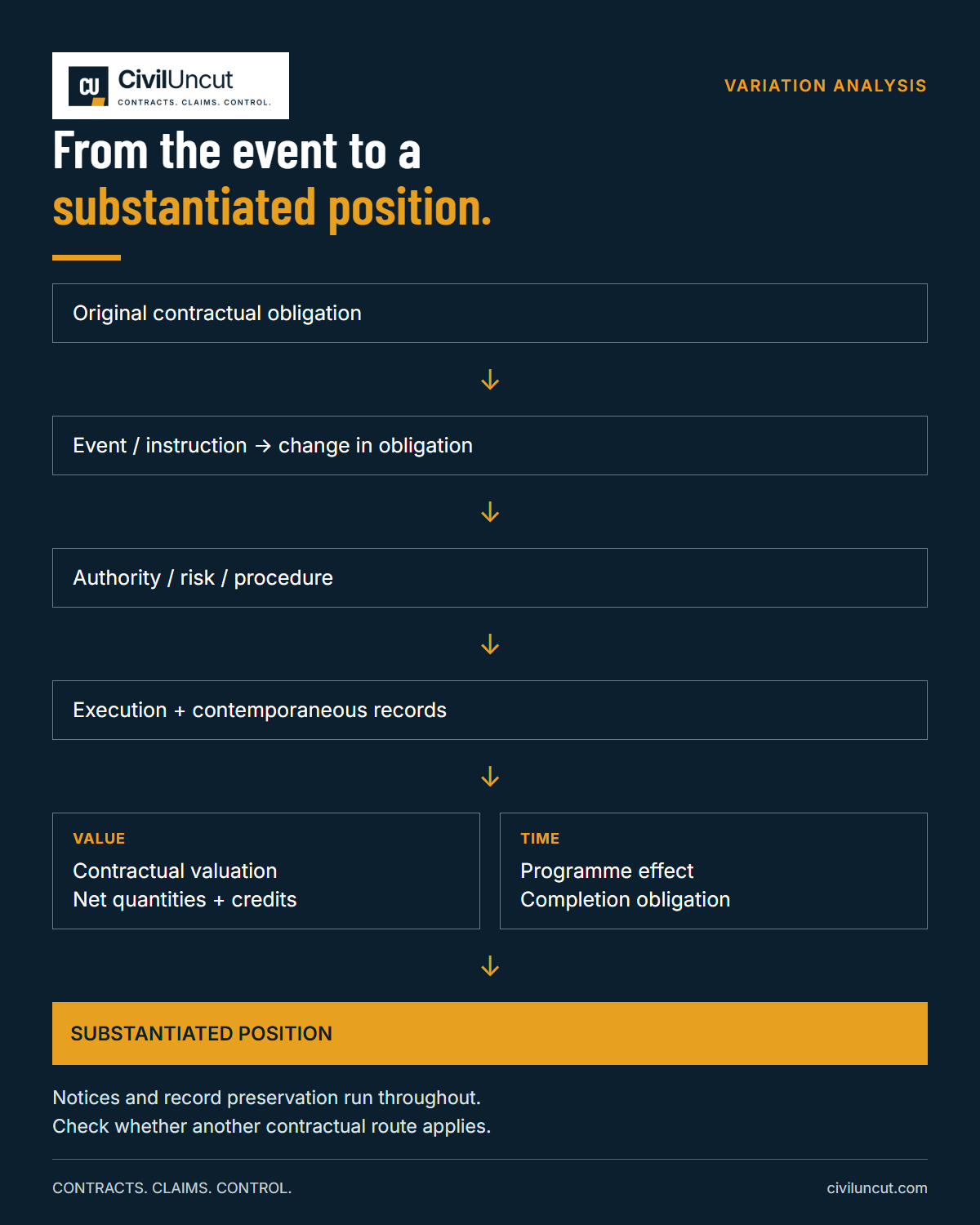
- DEFINE THE ORIGINAL OBLIGATION
- IDENTIFY THE CHANGE
- VERIFY AUTHORITY
- FOLLOW PROCEDURE
- PRESERVE RECORDS
- ASSESS VALUE
- ASSESS TIME
- SUBSTANTIATE THE POSITION
Define the original obligation. Identify the change. Verify authority. Follow procedure. Preserve records. Assess value. Assess time. Substantiate the position.
Notice and evidence preservation run throughout. Value and time are assessed alongside each other. If the event belongs under remeasurement, existing scope or another relief provision, record that conclusion rather than forcing it into a Variation claim.
The resulting position should state its contractual basis, execution status, procedural position, net valuation and time effect, with agreed, disputed and pending matters clearly identified.
Working through a change on a live project?
Start by separating the original obligation, the change itself, contractual authority, valuation and time effect.
CivilUncut tools for structured variation review are under development.