Contracts & Claims / CU-CONT-003 / V1.0
A Notice Is Not Just a Letter: How to Build a Contractual Notice That Actually Protects Your Position
Correspondence records the issue. A contractual notice must do the job required by the Contract.
A Contractor has written ten letters about unavailable ROW. The obstruction appears in monthly reports. It has been discussed at progress meetings. Months later, the time-extension submission receives a familiar response: “Where is the contractual notice?”
The file proves that people knew about the problem. Whether it proves compliance with the notice requirement is another question.
A letter, email, RFI or meeting minute may satisfy a particular requirement. It may also record an issue without notifying the contractual position that needed to be notified. The number of letters does not decide that question.
For the project team, the useful test is: what did this Contract require us to communicate, when, to whom, and how—and can we demonstrate that we did it?
1. Start With the Trigger
Start with the event, not the letter template. Identify what happened, where it happened and which obligation or activity it affected. Then identify the condition that activates the relevant notice provision.
The trigger might refer to an event, awareness of a circumstance, an instruction or an anticipated effect. Those formulations need different factual enquiries. Do not assume that the date work stopped is necessarily the date the notice period began.
Keep separate dates for occurrence, discovery, receipt of information and the point at which an effect became apparent. Where the wording includes what the Contractor should have known, consider the earlier site records, not only the date the contracts team opened its file.
A drawing register might show that the site team received a revision before the commercial team recognised its significance. Preserve both facts. Choosing the later date because it produces a more comfortable deadline weakens the chronology.
Record uncertainties openly. A disputed trigger date needs prompt review; it should not remain hidden inside an apparently precise deadline calculation.
2. Find the Clause Before Drafting
Identify the contractual route and the obligation behind it. Delayed access, design review, change of scope and utility interference should not automatically be processed under one generic “claim notice” heading.
Read the event-specific provision with the claims and communications provisions, definitions, schedules and amendments. An event may require both an operational communication and a contractual notification. Check whether separate time, cost or change procedures apply.
Identifying the clause internally is drafting discipline. Whether the initial notice must expressly cite it is a different, wording-dependent question. Seppälä’s FIDIC-hosted discussion of the 1999 forms, section III.A, distinguishes the initial notice from later substantiation and does not treat clause citation as an initial requirement in that discussion. That is no reason to omit a reference where your Contract requires one.
Record the exact edition and incorporated amendments. FIDIC’s reprint announcement shows why “FIDIC 2017” alone is an incomplete document description. An amendment published later does not automatically become part of an already executed agreement.
3. Establish Timing Without Inventing a Universal Deadline
Put the timing rule beside the chronology. Check the trigger, calendar or business-day definition, any promptness requirement, and whether compliance turns on sending, delivery or deemed receipt. Then check what must be included at that stage.
The historical NHAI NH-31D EPC tender, clauses 10.5.2–10.5.5, illustrates an awareness-based notice, express consequences and further submissions for continuing effects. It is an example of a particular agreement, not a deadline to import into another highway project.
Separate the initial notification date from dates for interim particulars, the detailed submission and a final update after effects cease. The fact that an obstruction continues does not establish that the initial clock restarts each day.
Where an earlier notice is required, waiting for final quantum can create a procedural problem. Equally, an empty notification cannot be assumed sufficient if the clause requires particulars now. State what is known, supply the required current material and identify what will follow.
If lateness is possible, preserve the chronology and obtain contract-specific review immediately. Do not backdate correspondence or pronounce the claim automatically lost without examining the wording and applicable law.
4. Serve the Required Recipient
The person who can solve the site problem may differ from the person who must receive the notice. A Resident Engineer, design reviewer, Authority representative and Authority’s Engineer are not interchangeable labels.
Check the named recipient, current appointment, address, mandatory copies and any relevant delegation. Confirm changes against the formal project record. A familiar email address is not evidence that the contractual route has changed.
Copying the Engineer is not necessarily the same as serving the specified recipient. Conversely, the presence of a name in the CC field does not by itself decide noncompliance. Test the required delivery, content and evidence rather than relying on email-field labels.
Read specific and general provisions together. In the NHAI example, clause 10.5.2 identifies the Authority’s Engineer and a copy to the Authority; clause 27.13 separately deals with communications between the parties. Their interaction needs attention, not a generic distribution list.
Keep evidence of who actually received which document and when. A dispatch register proves a dispatch entry. It does not, without more, establish every fact required by a receipt-based provision.
5. Check Form and Delivery
Review the permitted or required channel: letter, email, contractual platform or a combination. Check signature authority, language, designated address, required identification and any delivery or acknowledgement mechanism. A platform used for drawings may not be the specified notice channel.
The label matters when the Contract makes it matter. FIDIC’s hosted presentation on the 2017 provisions, particularly slide 5, explains an expressly identified Notice and the communication requirements. That defeats the broad claim that substance always overrides form.
The opposite shortcut also fails: writing “CONTRACTUAL NOTICE” at the top does not establish timely delivery, the correct recipient or adequate content.
Use a distinct, traceable document as a practical drafting approach. Preserve the issued version, attachments, transmission record and available delivery evidence. Check that attachments were actually included and accessible.
Oral directions and meetings should be recorded promptly. Where the Contract requires written confirmation or a separate notice, carry out that step. A minute recording an instruction and the Contractor’s notice about its consequences perform different functions.
6. State the Event So Someone Else Can Identify It
Describe the event precisely enough to distinguish it from other issues on the project. Include relevant dates, location or chainage, drawing revision, instruction reference, affected work and present status. Separate observed facts from provisional assessment.
“Drawings delayed and progress affected” leaves too much unresolved. Identify the drawing, the submission and response history, the activity needing it and the current restriction. If contractual responsibility is disputed, explain the asserted basis without presenting a disputed conclusion as an agreed fact.
Tie the notice to its supporting references. Avoid sending an unindexed correspondence bundle and expecting the recipient to discover which event is being notified. Several problems described in one letter may also require separate contractual treatment.
Ask a colleague who has not attended the meetings to review the draft. Can they identify the event and understand what is being notified without reconstructing months of email chains? This is a practical clarity check, not a substitute for the clause’s required contents.
7. State the Contractual Position, Not Just “All Rights Reserved”
Make clear what communication you are issuing and the right or potential relief it concerns, to the extent required and supported. Distinguish a request to remove an obstruction from notification of its possible contractual consequences.
Be accurate about present knowledge. An assessment may still be developing. Say which work is affected, what consequence is being examined and what particulars remain outstanding. Do not turn uncertainty into an unsupported claim for the entire period or cost.
A reservation can help express the position. It does not demonstrate that the timing, recipient, delivery and content requirements were met. Generic “all rights reserved” wording should never replace the actual notice analysis.
The same discipline applies when replying to a disputed instruction. Record the instruction and the issue requiring determination, follow the relevant procedure and preserve the appropriate position. This article does not determine whether you must proceed, may suspend or can refuse work; those are separate contractual questions.
8. Connect Contemporary Records
Build an event file that can be followed from the notice to the site record. Reference the relevant daily report, drawing, instruction, possession record, photograph or measurement rather than merely saying “records available”.
The SCL Delay and Disruption Protocol, Core Principles 1, 3 and 4, supports disciplined procedure, records and contemporaneous assessment. It is methodological guidance, not an Indian entitlement rule.
For the CivilUncut review, assign an event reference and retain original files, revisions and transmission evidence. Link site entries to locations and programme activities. Keep the programme status immediately before the event and record subsequent changes with explanations.
Record what remained possible as well as what stopped. If resources moved to another work front, preserve that fact. If materials were not ready, retain that information too. A selective obstruction diary can describe the event while concealing another reason the activity could not proceed.
Distinguish records demonstrating notice delivery from records supporting the underlying claim. Both matter; one cannot stand in for the other.
9. Follow the Event Beyond the First Notice
Giving the initial notice may start a procedure rather than complete it. Identify required interim updates, further particulars, detailed submissions and any response or dispute steps. Allocate an owner and a reviewed due date to each action.
For a continuing event, record changes in location, extent and effect. Partial ROW release may change the affected activities without ending every consequence. Equally, an obstruction may end before its procurement or resequencing effects end. Explain the distinction using evidence.
When the event changes materially, examine whether the existing notice covers it or a separate notification is required. Do not use one old notice as a permanent umbrella for every later problem.
Read responses carefully. An acknowledgement is not necessarily acceptance of entitlement. If the recipient has understood a different event, clarify promptly and preserve the correspondence. If a submission is rejected, identify the applicable next step rather than leaving it in the monthly reminder cycle.
10. Develop Impact and Quantification Separately
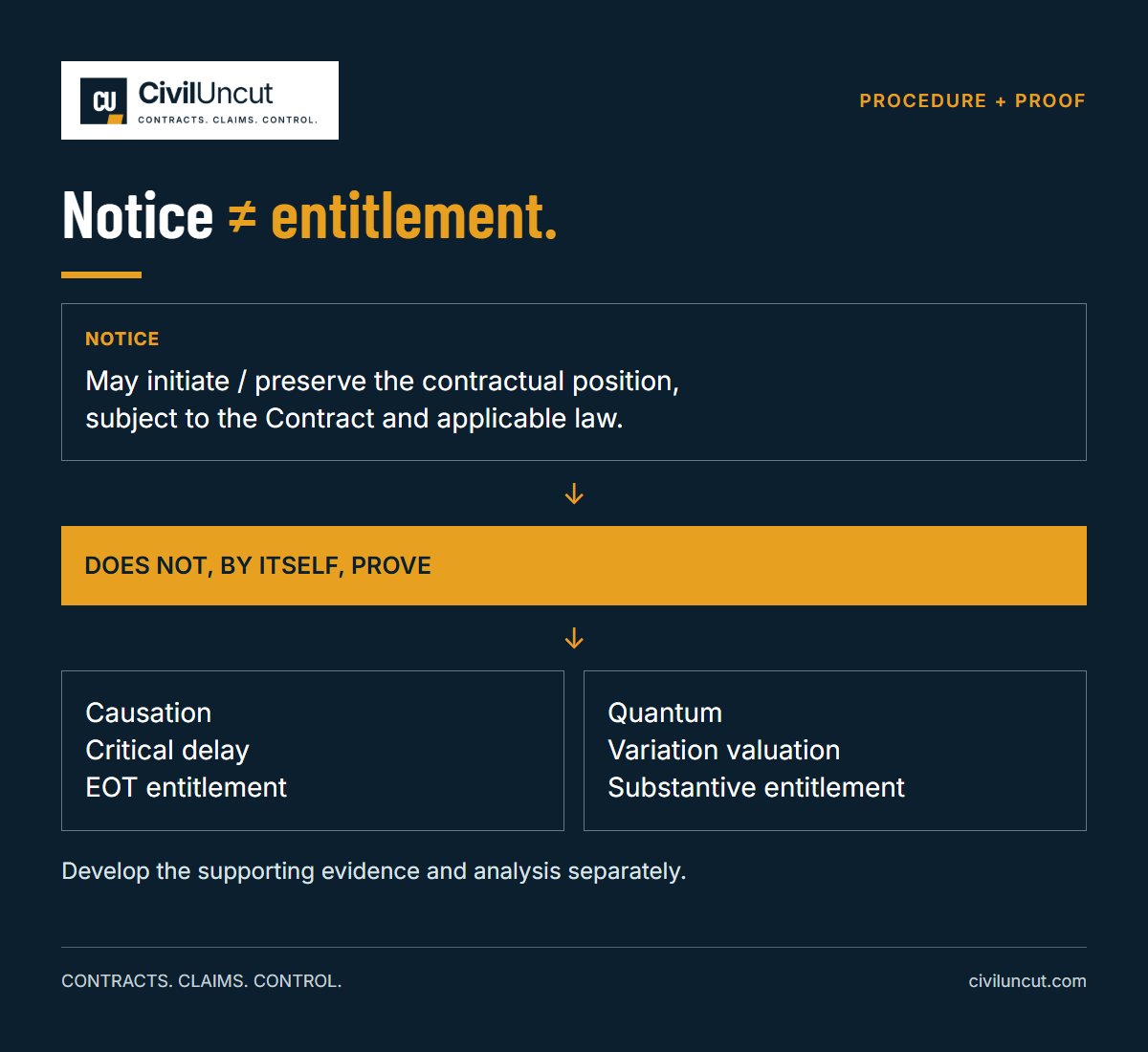
A notice does not prove causation, critical delay, prolongation cost, variation valuation or EOT entitlement. Those require the relevant substantive basis and supporting analysis.
For time, identify affected activities, their status, links to the relevant Project Milestone or Scheduled Completion Date, and the effect demonstrated under the Contract. Address other operative causes and mitigation. Event duration is not automatically the extension due, as explained in A Delay Does Not Automatically Give You EOT.
For changed work, establish the original and changed obligations, authority and applicable valuation route. A Variation Is Not Just Extra Work develops that separate enquiry. A notice mentioning “variation” does not establish a payable change.
Where costs are pursued, identify the recoverable head and connect the calculation to the event and records. Explain estimates, assumptions and later revisions. Avoid treating the notice file as a substitute for measurement, rate analysis or proof of expenditure where required.
Start this assessment while the notice process runs. It need not wait until every effect has ended.
Four Infrastructure Situations to Test
These are fictional teaching examples, not reported projects or entitlement outcomes.
Late ROW or site access. A drainage frontage remains occupied when the programme requires access. Examine the contractual handover obligation and the trigger for relief; the Appointed Date alone does not answer either. The weak response is repeated requests to “make land available”. A stronger approach identifies the frontage, obligation, relevant dates, restriction and contractual position through the required route. Preserve possession records, chainage maps, diaries and programme status. Update partial releases and continuing effects. Responsibility, readiness, the affected works and the completion consequence still need substantiation.
Delayed drawing or approval. A pier reinforcement drawing remains under review when steel must be released. Check whether the submission was complete and compliant, what review obligation applied and when the information was needed. An “urgent” RFI may request action without giving the required notice. Identify the revision, transmittal, review history and potential consequence. Keep comments, resubmissions, procurement logic and programme records. Follow up after the response and assess actual effects. Contractor design correction, late submission and genuine review delay must be distinguished before attributing time or cost.
Changed work or instruction. A site representative asks for a wider roadside drain. Examine whether this changes the original obligation and whether the issuer has relevant authority. A measurement entry is a weak substitute for the change procedure. Confirm the direction as required and address change and time notifications separately where applicable. Preserve baseline and revised drawings, instruction evidence, quantities and resources. Follow through on the proposal, order or determination process. The notice does not settle authority, variation entitlement, valuation or programme impact.
Utility obstruction or third-party interface. An unrecorded live duct interrupts station excavation. Check utility and interface responsibilities before attributing the risk. Writing only to the utility owner may advance coordination while leaving contractual notification unresolved. Record the location, discovery, restriction and safe alternatives, and notify the required contractual recipient. Preserve surveys, permits, utility correspondence, diaries and resource movements. Update clearance or redesign and effects cessation. Risk allocation, foreseeability where relevant, mitigation, criticality and recoverable cost remain separate questions.
Review the Whole Notice Position
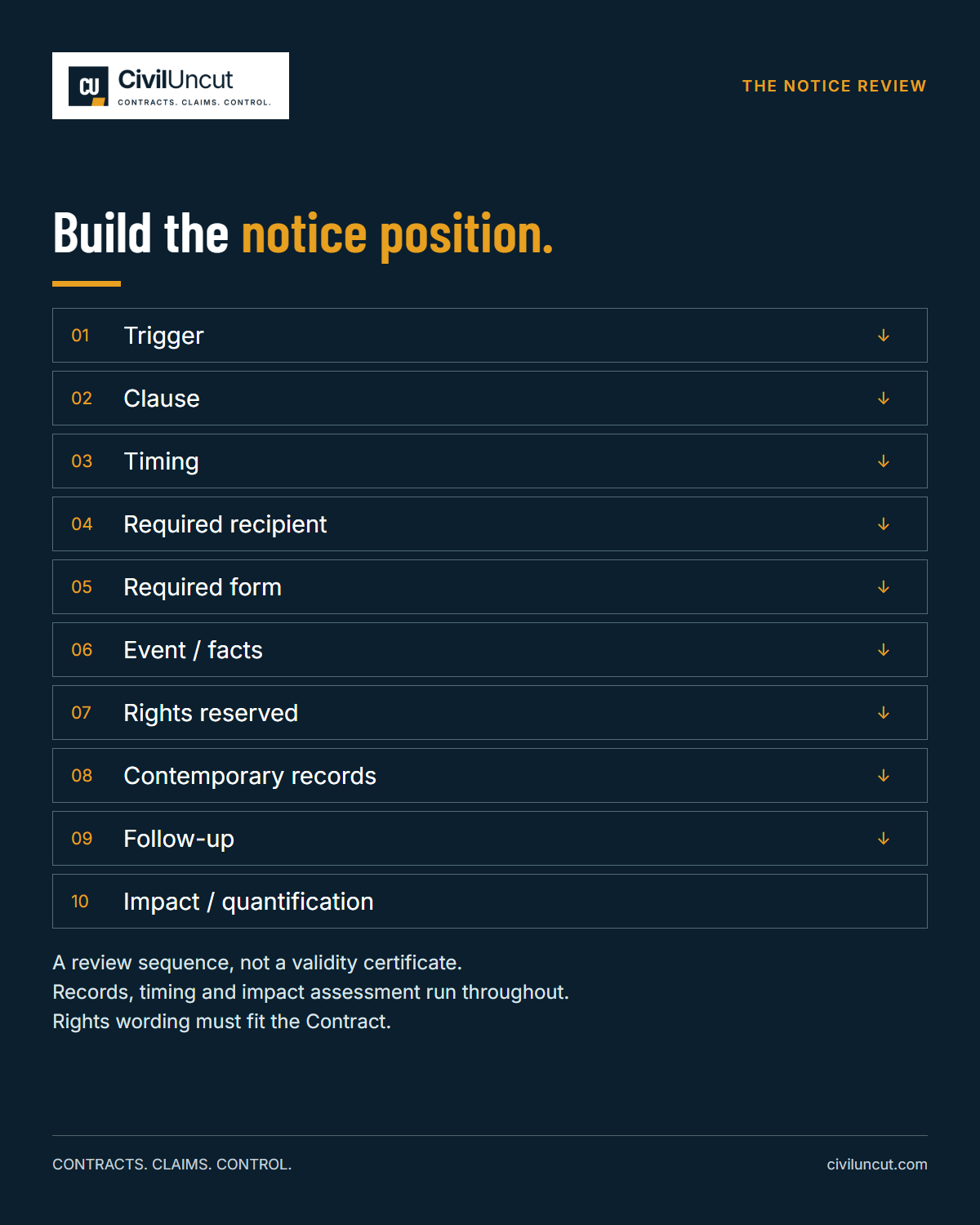
Use the CivilUncut sequence as a review framework: Trigger → Clause → Timing → Required recipient → Required form → Event/facts → Rights reserved → Contemporary records → Follow-up → Impact/quantification.
It is not a universal contractual procedure or a ten-box validity certificate. Clause and trigger require repeated cross-checking. Records, timing controls and impact assessment run throughout, not only when their numbered stage is reached.
For an existing letter, compare each requirement with the issued document and delivery evidence. Record three distinct conditions: demonstrated, unresolved, or an apparent departure requiring review. Do not record “notice complied” merely because a letter reference exists.
For a draft, identify the issue owner, recipient, delivery route and next submission before release. After issue, add the actual delivery evidence. A completed draft review is not evidence that service occurred.
The free EOT Event Documentation Checklist can help organise event records. It does not replace this contract-specific notice review.
What If the Other Side Already Knew?
Knowledge of a problem and compliance with a particular notice requirement are different enquiries. In Glen Water v Northern Ireland Water (2017 NIQB 20), the court’s analysis of the correspondence and discussions did not establish notification of the specific claim. That foreign, contract-specific decision is an illustration, not a rule of Indian law.
Arguments about actual knowledge, waiver, estoppel, prevention or the enforceability of a time bar require review of the executed wording, conduct, governing law and jurisdiction. This framework does not decide them. Preserve relevant evidence and seek professional review if reliance on an earlier communication is disputed.
The practical question remains precise: can the project team show which contractual requirement its communication satisfied—and what remains to be done?
Frequently Asked Questions
Can an email be a contractual notice?
Possibly. Check the permitted channel, required content, identification, recipient and delivery provisions. An email being read does not answer every requirement; a paper letter is not automatically sufficient either.
Must I wait until the delay or cost is quantified?
Follow the initial submission requirement. Where earlier notice is required, do not wait for final quantification. Supply the material required now and track later particulars. Different forms require different levels of initial detail.
Does a notice headed “all rights reserved” protect the claim?
That heading alone establishes neither procedural compliance nor substantive entitlement. Review the trigger, clause, timing, recipient, form and contents, then the records and follow-up. The underlying claim still needs proof.
Technical Note
This is contract-administration guidance for project review, not a project-specific legal opinion. The linked NHAI agreement is historical; FIDIC material is edition-specific; SCL is guidance. Use the executed Contract and amendments. The title describes the task of protecting a position, not a guarantee that a particular notice achieves it.