Project Controls / CU-CONT-004 / V1.0
Daily Site Records Are Not Admin: What to Capture Before the Evidence Disappears
A daily report is useful when someone who was not there can reconstruct what happened.

Six months after a utility obstruction, the project team opens the daily reports. The same sentence appears repeatedly: “Work affected due to utility.” The reports were issued. The dates are available. There is even a photograph folder.
But which excavation was stopped? For which part of the shift? Was the crew ready? Did the excavator move to another location? Was the photographed duct inside the proposed trench or beside it?
The record exists. The answers may not.
Daily site records are not valuable simply because they fill a reporting requirement. They need to preserve facts that remain usable after the work is covered, people move projects and recollections diverge. Record the condition, not just the complaint.
1. Decide What the Record Needs to Explain
A diary is a format. Evidence is information used to support a proposition. Calling a document a daily diary does not establish its accuracy, completeness or relevance to the question being examined.
Start with the practical reconstruction question: could another engineer identify the work, its status, the condition encountered and what the team did next? A narrative about the whole package may not answer that for a particular pier, drainage reach or possession window.
Separate direct observation from information reported by someone else. Identify the source of a reported fact. Keep an assessment such as “likely to affect the next pour” distinguishable from an observation such as “reinforcement inspection remained outstanding at shift end”.
Check prescribed record obligations too. The historical NHAI NH-31D EPC agreement, Article 11, addresses construction records, progress reports and inspection separately. It illustrates why completing one report cannot be assumed to satisfy every project requirement. Use the executed Contract, quality plan and applicable procedures for your project.
2. Give Every Entry an Identity
Put the project, date, shift or observation period, author and location against the entry. Distinguish the time of the event from the time someone entered it into the system. Where a later correction is needed, retain an intelligible correction history.
“Near bridge” is insufficient when the package contains several structures. Use the structure number, chainage, carriageway, span, level or grid reference that lets someone find the same work again. A photograph reference should lead to the same identified location.
Connect the entry to an activity or work package. Use the programme activity reference where practical, but include a plain description as well. Codes change; a future reviewer should not need an obsolete lookup table to understand which operation was affected.
For linear work, record the limits of the affected reach. Do not turn an obstruction at one crossing into a description of the entire highway. For a station or bridge, identify the work face and relevant interface, not only the project name.
3. Put Planned and Actual Work Beside Each Other
State what the team intended to execute during the period and what it actually executed. Identify the planning source: the contemporaneous programme, look-ahead, approved sequence or shift plan. These documents have different purposes; retain the relevant version.
If no operation had been planned at the affected location, record that honestly. Do not retrofit a later recovery programme to suggest work was intended there all along.
Actual work needs an intelligible extent. Identify the operation completed, partly completed, suspended or not started. Distinguish installed work from deliveries, preparation and rework. If the day’s progress differs from the plan, identify the observed reasons without prematurely deciding liability.
A plan-to-actual comparison should also capture work completed elsewhere. Otherwise, a daily report may support the statement “this front was unavailable” while obscuring the fact that the same crew progressed another front.
The SCL Delay and Disruption Protocol, Appendix B, distinguishes raw progress information from compiled reports and relates records to programmes and resources. It is useful methodological guidance, not a substitute for the project’s contractual requirements.
4. Record Resources by Activity and Status
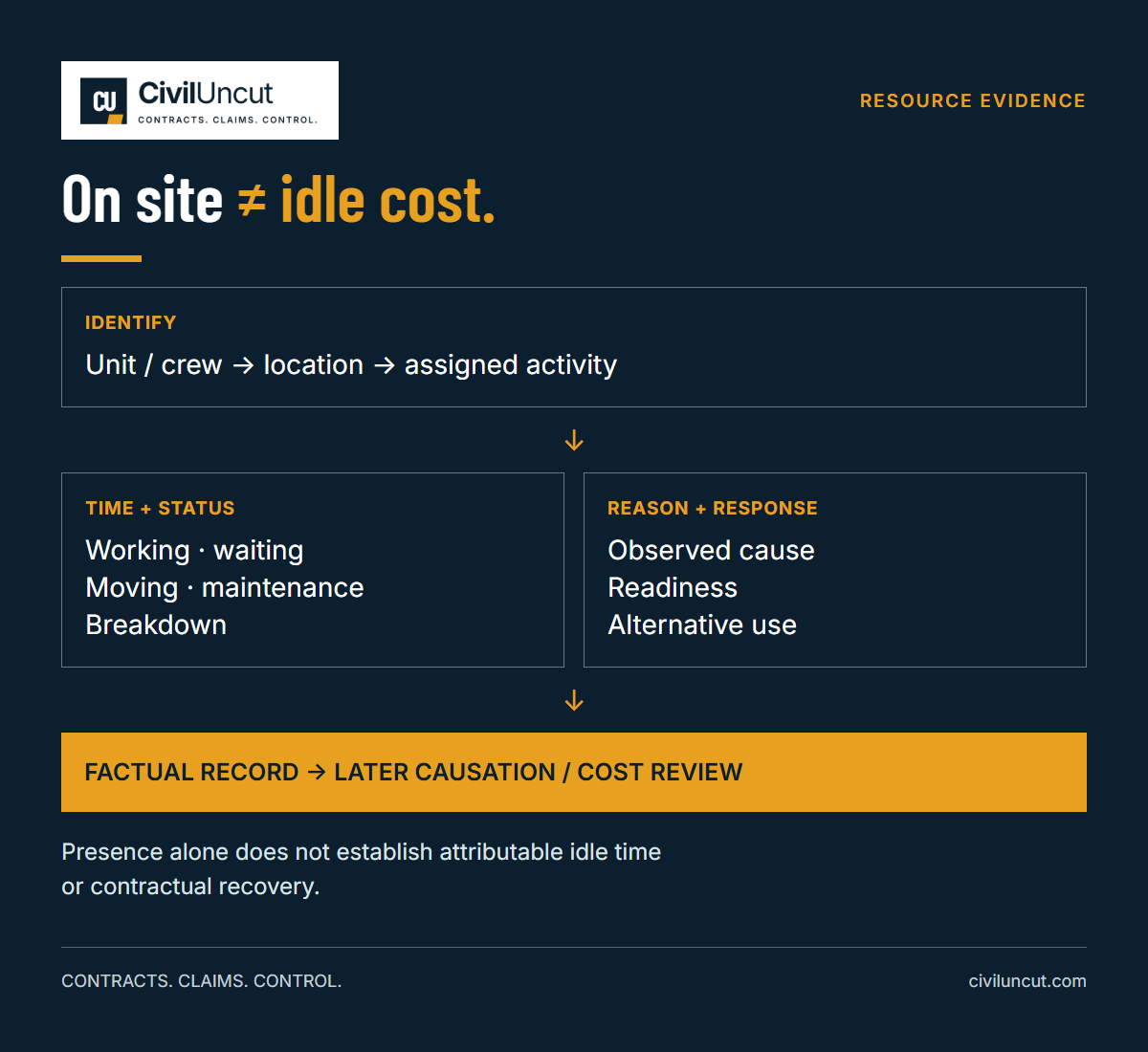
A manpower total and equipment list establish only part of the day. They may show presence or allocation. They do not automatically establish productive time, standby caused by an obstruction or a recoverable idle-resource cost.
Identify the crew or equipment unit, location, assigned operation and relevant time bands. Distinguish working, waiting, breakdown, maintenance, movement and release. Record the reason for inactivity as observed, with the source where another person supplied it.
Where a machine serves several fronts, preserve the allocation or movement log. Avoid showing the same available hours against two events. Reconcile shift records with equipment logs and other relevant operational records rather than relying on a single summary label.
Do not equate engine-running hours with productive hours without understanding what the machine was doing. Equally, zero output does not establish that an otherwise ready resource was idle because of the Employer. There may have been a breakdown, unavailable material or incomplete predecessor activity.
Cost recovery comes later. The daily record should make the factual resource status examinable before anyone selects a rate.
5. Capture Access and Readiness Together
“Access unavailable” is useful information, but it leaves a second question: was the affected operation otherwise ready to proceed?
Record the relevant drawing status, material availability, predecessor completion, permits or work-window conditions and resource readiness. Not every field applies to every activity. Identify what mattered to this operation and state what is unknown.
For partial access, use a marked plan or chainage record. Distinguish land possession from usable construction access and access from permission to carry out a particular operation. Do not assume that handing over a boundary strip means a rig can reach the work face.
Record available alternatives and what was actually done with them. If resequencing was impractical, preserve the reason: unsuitable access, an incomplete interface, equipment limitations or another evidenced constraint. “No alternative possible” needs more than repetition.
This is factual preparation for later causation analysis. The daily author need not decide EOT, concurrency or compensation. The author should preserve enough information for those questions to be examined fairly.
6. Keep the Instruction and Execution Trail Connected
Record who gave the direction, when, what was requested and the document or meeting reference. Keep the original requirement and revised drawing identifiable. Record whether confirmation, authority or commercial treatment remains unresolved.
For oral directions, follow the Contract’s confirmation procedure where applicable. A site diary entry is not automatically the written confirmation or contractual notice required. Link the entry to subsequent correspondence without rewriting its original date or content.
The Coal India civil engineering manual, updated through October 2023, section 8.09, illustrates formal site-order and hindrance records. Its controls are organisation-specific; the useful question for another project is which record carries which function under its own arrangement.
Keep execution facts separate from the contractual conclusion. A direction was received; a drawing changed; a quantity was executed. Whether that establishes an authorised payable change is addressed in A Variation Is Not Just Extra Work. The daily record supplies the facts rather than pre-deciding that enquiry.
7. Make Quantities Traceable
Record the item or operation, unit, measured extent, location and measurement reference. Distinguish a provisional progress estimate from an agreed measurement. Explain revisions so the following day’s cumulative quantity can be reconciled with the previous record.
If a quantity includes rework, replacement or an omitted element, make that visible. An undifferentiated “concrete completed” total may be adequate for a dashboard and inadequate for a later change assessment.
Preserve inspection requests, survey sheets, pour records or other relevant supporting documents before the work disappears from view. Where the Contract requires inspection or measurement before covering up, a photograph is not a replacement for that procedure. The NHAI example’s clause 11.11 is one illustration of a separate pre-cover mechanism; its detailed conditions should not be transplanted into other projects.
A quantity record can help establish what was executed. It does not, by itself, establish compliance, the applicable payment item, rate, variation authority or entitlement. Keep those review questions open rather than embedding an unsupported commercial conclusion in the daily report.
8. Record Weather Only as Far as It Explains the Work
A weather entry should identify conditions relevant to the operation, the period affected and the source of any measurement. “Rainy” does not explain whether concreting stopped, hauling became impractical or work continued normally under protection.
Distinguish observed conditions from a reading taken elsewhere. If an off-site station is used, identify it and leave its representativeness open to examination. Do not invent on-site rainfall values from a general forecast.
Keep the operational response: protection installed, pumping, recovery work, stopped activities and activities that continued. Weather occurrence, its practical effect and the contractual treatment of that effect are separate matters.
For an office drawing-review event, weather may be irrelevant. A useful record system permits that conclusion with a reason rather than encouraging copied weather text in every event file.
9. Give Photographs and Joint Records Context
A photograph captures a view. It does not automatically identify the whole obstruction, its duration or who was responsible. Keep the original file and a reliable index stating location, subject, date and viewing direction where useful.
Link photographs to the relevant entry or marked plan. Use a wider view to locate the subject and detail views for the particular condition. Record later changes from a comparable viewpoint where practicable. Avoid treating image metadata alone as conclusive proof of authenticity or timing.
For joint records, identify participants, date, subject, documents considered and the matters actually agreed. Keep reservations and disagreements visible. A signature acknowledging inspection should not casually be described as agreement to every later claim arising from it.
If someone does not attend or declines to sign, record the invitation, attendance and response accurately. Do not silently label the record “jointly agreed”. The contractual or legal consequence of disputed evidence needs separate review; the record should preserve the disagreement, not conceal it.
10. Keep Summaries Connected to Their Sources
Here, DPR means Daily Progress Report and MPR means Monthly Progress Report. Projects may use those abbreviations differently; define them in the document system.
A DPR can contain useful event evidence. An MPR can explain trends. Neither title guarantees the detail needed to examine a particular event. Aggregation may hide when a constraint began, which front was affected or why one resource stopped while another continued.
IIT Bombay’s 2024 infrastructure PMC procurement document, Part II Annexure II.3, provides a project-specific example of detailed site records alongside periodic reports. It is not a universal checklist, but it demonstrates why the underlying document set matters.
Use a consistent event reference across the daily entry, instruction, drawing, inspection, programme note and resource record. An index should take the reviewer to the source document and relevant part, not just to a folder containing hundreds of files.
Reconcile summary figures to source records before issue. If an MPR corrects earlier progress, retain the basis for the adjustment. Do not make the original record disappear to produce a tidier history.
Five Situations Where Detail Changes the Review
The following are fictional infrastructure examples. They describe records to preserve, not predetermined entitlement outcomes.
ROW obstruction on a highway. The daily entry says a drainage reach was unavailable. Improve it with chainage limits, a possession reference, the planned operation and the actual condition preventing access. Record whether the crew, drawings and materials were ready and what progressed on neighbouring reaches. Keep the marked plan and photograph references. As access changes, update the affected extent. Later analysis still needs to establish responsibility and the consequence for the relevant completion obligation; obstruction duration alone does not answer it.
Utility conflict at an urban station. Excavation encounters a duct whose ownership is initially uncertain. Record its verified location, how it was identified, the work restriction and the safe response. Separate confirmed survey information from assumptions. Link the utility communication and record work moved elsewhere. Update the entry after identification, protection, shifting or redesign. This preserves the changing event without prematurely deciding whether it was foreseeable or contractually allocated to the Contractor.
Drawing delay at a bridge pier. The report repeatedly says “drawing pending”. Identify the revision, submission and comments, current response status, intended steel-release activity and the reason it requires that drawing. Record whether resubmission or Contractor design work was also outstanding. Link the drawing register and procurement status. The later reviewer can then distinguish waiting for a response from waiting for a compliant submission, instead of attributing every day to the same cause.
Changed work to a retaining wall. A direction alters the wall geometry during execution. Preserve the original and revised drawings, the direction reference, the work already completed and the quantity difference. Record additions, omissions and any work removed or repeated separately. Note unresolved confirmation or authority without inventing approval. The resulting file supports a later scope and valuation review; it does not establish a payable Variation merely because more concrete appears in the daily total.
An idle piling-rig allegation. The equipment list shows a rig on site during an obstruction. Capture its unit reference, location, planned task and inactive periods. Retain breakdown, maintenance and movement records, including work performed on another pile. Explain why any remaining waiting time occurred and what alternatives were considered. The file should permit a reviewer to examine attributable inactivity. It should not turn every day between mobilisation and demobilisation into an assumed recoverable idle day.
Protect the Record Without Rewriting History
Use the project’s controlled document system and maintain retrievable source files. Preserve authorship, dates, versions and links when exporting records or changing systems. A scanned bundle may be convenient for review, but it should not become the only surviving form where useful native data would be lost.
The CPWD section of the 2023–24 annual report describes electronic measurement and observation workflows alongside verification and approval. That is evidence of a digital workflow initiative at that time, not proof that a digital entry is automatically correct or accepted.
Mark late entries and reconstructed accounts honestly, including the sources used and remaining uncertainty. Keep corrections traceable. Do not backdate a recollection to make it look contemporaneous.
Allocate record ownership before the next shift: who observes, who checks, who files and who follows up missing references? At staff handover, test whether another person can retrieve and understand an event without calling the original author. Follow the applicable confidentiality, access and retention requirements; no universal retention period is proposed here.
The CivilUncut Daily Record Review
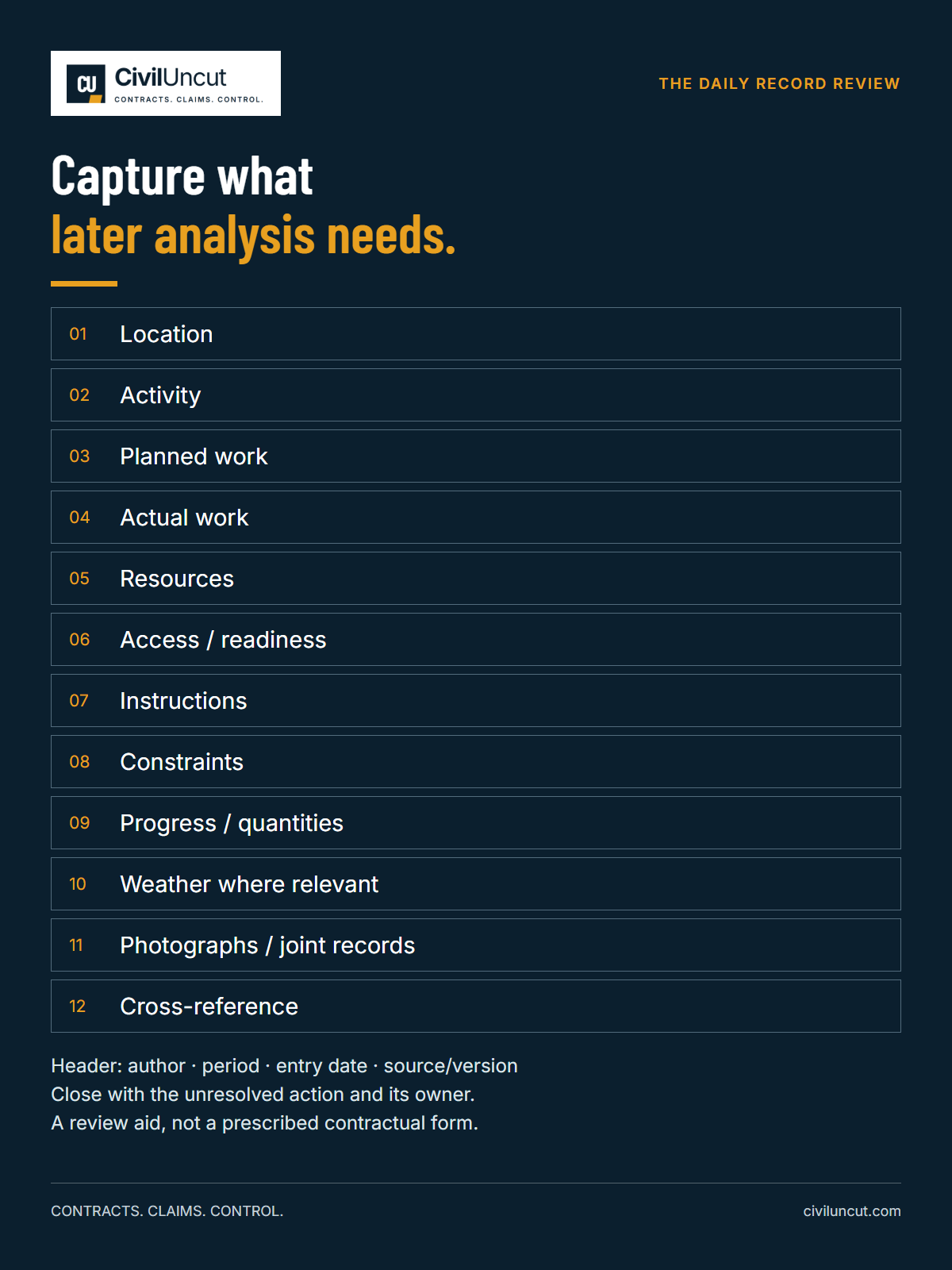
Use this sequence: Location → Activity → Planned work → Actual work → Resources → Access/readiness → Instructions → Constraints → Progress/quantities → Weather where relevant → Photographs/joint records → Cross-reference.
Add the identity header: author, observation period, entry date and source/version. Close with the unresolved action and its owner. The sequence is a review aid, not a prescribed contractual form.
Before accepting the day’s record, ask whether another engineer can locate the work, compare the plan with actual execution, identify resource status, understand the constraint and retrieve the supporting material. Ask what changed since the previous entry. A copied sentence may be accurate, but it should not conceal a partial release, new cause or changed response.
Keep adverse facts too. A missing material, incomplete predecessor or equipment fault belongs in the history even when it complicates a preferred commercial narrative. Unknown information should remain visibly unknown until checked.
Then separate the next decisions. EOT analysis examines completion consequences. Contractual notice review examines the required communication. The EOT Event Documentation Checklist can help organise a related event file. None of those tasks is completed merely by issuing the DPR.
Technical Note
This is a practitioner framework for record quality, not a finding about legal admissibility, contractual entitlement or recoverable cost. Sources include historical/project-specific Indian documents and SCL guidance. Apply the executed Contract, amendments and record procedures. Obtain project-specific professional review for disputed legal consequences. The objective is a reconstructable factual record, including its gaps—not a guaranteed claim outcome.