Claims / CU-CONT-005 / V1.0
A Claim Is Only as Strong as Its Evidence: How to Build the Substantiation Chain
A claim file becomes useful when each important proposition can be traced to evidence, reasoning and an identified contractual basis.
A project team submits a claim with photographs, letters, daily reports and several spreadsheets. The annexures are substantial. The reviewer still asks: which obligation was affected, why did that affect completion, and how does that produce the amount claimed?
Adding another hundred pages will not necessarily answer those questions. The problem may be the connection between the records, rather than their number. More documents ≠ better substantiation.
For a contractor, the task is to make the position reviewable. For an Engineer or commercial reviewer, it is to identify which proposition is supported, contradicted or still unresolved. Neither task is completed by counting attachments.
Start With the Proposition, Not the Folder
“The Employer delayed us” contains several propositions. An event occurred. A contractual obligation or risk allocation connects that event to the Employer. Required procedures were followed. Particular work was affected. That effect caused the time or cost consequence claimed. The calculation uses an applicable recovery basis.
Separate those propositions before assembling the submission. A photograph might support the first. The executed agreement may support the second. Delivery evidence addresses part of the third. Programme analysis and cost reconciliation address later questions. One record can support several propositions, but rarely answers every question.
Write the proposition narrowly enough to test: “Access to the pier location was unavailable during the identified period,” rather than “the entire project was obstructed.” Then identify the next inference separately. Did that unavailability prevent planned foundation work? Did that work control the relevant milestone? What else was preventing it?
The practical standard is traceability: every material conclusion needs a visible bridge from source to reasoning. This is a review discipline, not a promise that a claim will succeed.
The CivilUncut Substantiation Chain
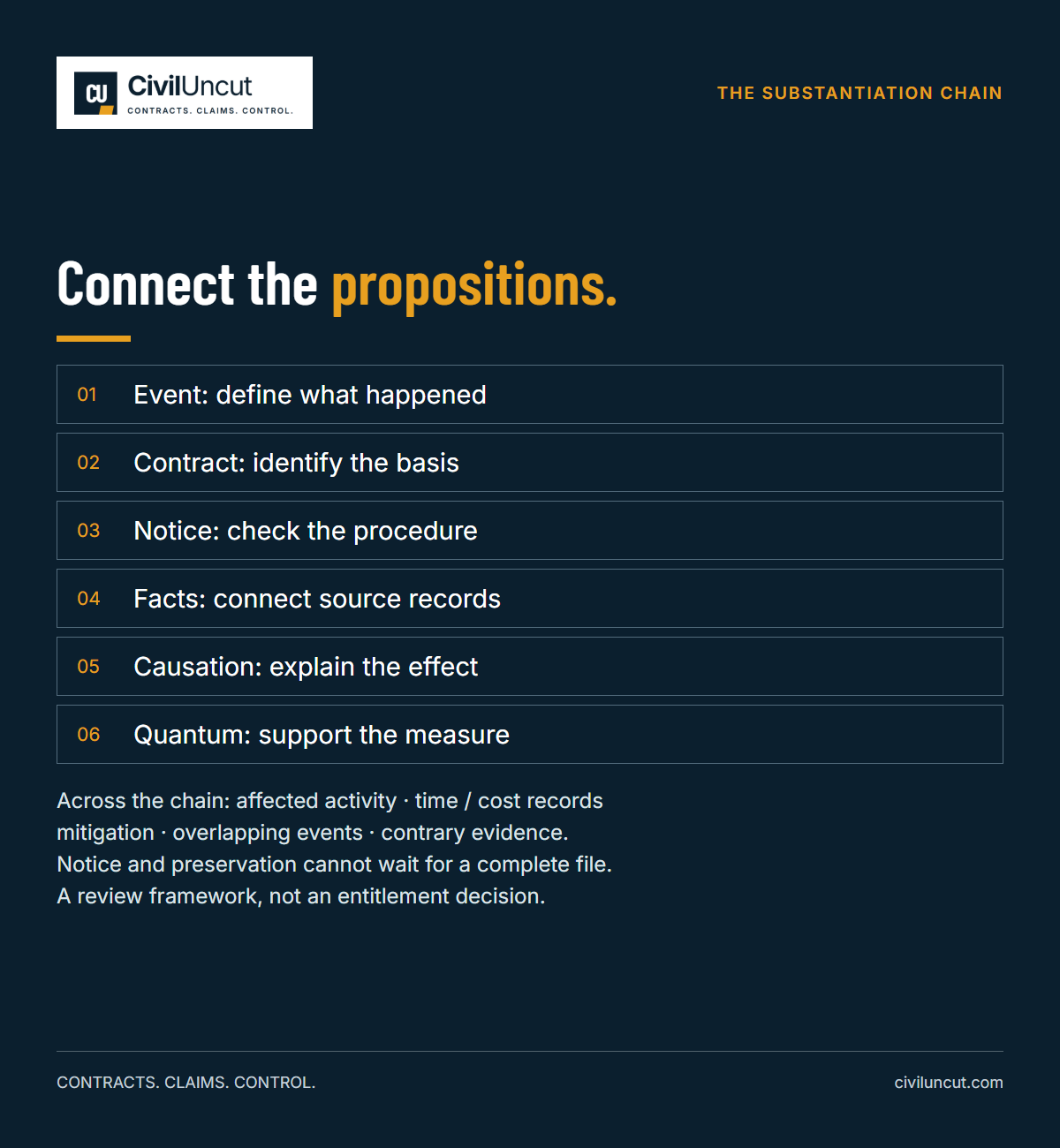
Use this sequence: event → contract → notice → contemporary fact → affected obligation/activity → causation → time/cost record → mitigation/concurrency → quantification → submission.
Treat it as a set of connected questions, not a waiting sequence. Notice obligations and evidence preservation may require action before the impact is known. Revisit the chain when a drawing, resource log or contrary letter changes the account. Separate time and money into their own branches rather than assuming one follows automatically from the other.
There are contractual examples behind these distinctions. The historical NHAI NH-31D EPC tender, clauses 10.5 and 13, separately addresses affected milestone completion, particulars for time claims, and Change of Scope administration. It is an example, not a template for every highway contract.
The FIDIC-hosted Seppälä paper on the 1999 forms, Part III.A, also distinguishes notice, contemporary records and detailed substantiation. Check the actual edition and amendments on your project. Do not borrow deadlines from a different contract merely because its terminology sounds familiar.
What Are You Trying to Prove?
For occurrence, use records that identify the condition, location and period: inspection notes, correspondence, photographs and joint observations. They may show a utility at the excavation face. They do not, by themselves, establish who accepted the risk of finding or relocating it.
For contractual responsibility, connect the event to the executed agreement, schedules, scope, drawings, amendments and relevant exclusions. State the obligation relied on and the alternative interpretation that needs answering. An Engineer acknowledging a physical condition is not necessarily agreeing liability for its consequences.
For procedural compliance, identify the required notice or submission, its trigger, recipient, form and delivery record. A notice register helps locate these items; it does not replace the issued communication. A later comprehensive claim file should not be assumed to cure an earlier procedural problem. Seek project-specific advice where the effect is disputed.
For causation, show the affected activity and explain the mechanism connecting the event to lost time, altered execution or additional resources. For quantum, show how the contractual valuation basis and the supported inputs produce the requested amount. Evidence that money was spent is a different proposition from evidence that another party must reimburse it.
Give Each Record a Defined Job
A contemporary letter records what its author communicated at that time. Its factual assertions still need examination. Meeting minutes can help establish decisions, observations and action owners, but identify whether the relevant passage was agreed, qualified or disputed. A signature on a measurement sheet should be read for what was measured and agreed, not expanded into acceptance of every commercial consequence.
DPRs, MPRs and site diaries offer context. Here, DPR means daily progress report; on other projects the same abbreviation means detailed project report. A monthly summary may establish an overall trend while concealing the specific shift or workfront relevant to the claim. Link the summary to its underlying source when that distinction matters.
Photographs show a field of view at a particular time. A picture of a barricade does not establish continuous obstruction throughout an asserted period, the availability of another access, or the readiness of the intended crew. Use the picture alongside location information, dated observations and the operational account; do not ask it to prove invisible facts.
Registers are navigation aids. An instruction register should lead to the actual instruction, its issuer, confirmation and relevant drawing. A cost register should lead to the supporting transaction or allocation. A populated row is not a substitute for the document it describes.
CU-CONT-004 explains how to capture useful daily site records. This article starts at the next task: selecting and connecting those records to a particular claim proposition.
Preserve the Difference Between Source and Reconstruction
A chronology prepared today can organise events from six months ago. It should identify today's preparation date, each source reference and any inferred date. Do not present a reconstructed sequence as though it were a diary written during the event.
Keep original records available alongside extracts and working calculations. Where a date comes from an interview rather than a contemporary record, say so. Where a spreadsheet allocates a shared invoice between activities, identify the allocation method and supporting assumptions. Another reviewer should be able to distinguish observed facts, later explanations and analytical judgements.
Contemporaneity does not make every entry correct. A daily report and plant log may disagree. Preserve the discrepancy, seek clarification and show what remains unresolved. Quietly selecting the favourable entry makes the file easier to challenge and harder to improve.
Build the Causal Bridge
A useful working chain might read: access condition → excavation activity unavailable → successor foundation pour displaced → relevant completion milestone affected. Each arrow needs an explanation. Include activity identifiers, the programme version and its status, actual progress, dependencies and the period being assessed.
The Department of Expenditure Works Manual, second edition 2025, section 7.4.2, treats the work programme as a reference for progress and delay assessment. For a particular claim, a programme printout alone still needs explanation: which relationship is being relied on, and does the recorded execution support it?
Test alternatives. Was an approval outstanding? Was the plant ready? Could another front proceed? Record the attempted mitigation, its timing and the operational reason an alternative was unavailable or only partly useful. Do not treat the existence of another workfront as proof that all loss was avoidable; establish whether the relevant resources and sequence could use it.
Identify overlapping events rather than mechanically adding their durations. Calendar overlap alone does not settle contractual concurrency or its consequences. Those questions need the relevant analysis, wording and legal review. For the underlying event-to-completion inquiry, use the CivilUncut EOT guide.
Keep Quantity, Cost and Recovery Basis Separate
Measurement records can support executed quantities. Drawings and specifications explain what those quantities represent. Valuation still needs the applicable item, rate, derived-rate mechanism, agreed change valuation or other contractual basis. Under some arrangements, payment follows defined stages rather than simple remeasurement of every quantity.
For a resource-based cost allegation, connect the resource identifier, claimed period, allocation and transaction. Payroll may support employment cost; deployment sheets help establish where the people worked. A hire invoice may support a charge; logs and hire terms help explain the period and use. Reconcile shared resources, credits and amounts already claimed or paid elsewhere.
The SCL Delay and Disruption Protocol, Part B sections 12, 18 and 20, distinguishes time relief from monetary recovery and makes prolongation recovery dependent on contract and cause. Its productivity guidance stresses comparable conditions. It is professional guidance with a UK focus, not Indian law or a replacement for the signed contract.
Choose the measure before calculating. If the contract prescribes a rate or formula, explain its application and inputs. If the claim relies on actual additional cost, show incurrence and attribution. A tender allowance, invoice total or EOT duration should not be silently substituted for the measure that the claim actually requires.
Scenario 1: ROW Was Blocked for Sixty Days
This and the following scenarios are fictional. A contractor asserts that unavailable ROW delayed a bridge milestone by sixty days. Dated joint inspections and location-specific photographs support the obstruction period. The contractual basis needs the relevant access obligation, handover schedule, exceptions and notice trail.
The weak pattern is sixty days of photographs followed by a sixty-day EOT request. The stronger chain joins the planned pier activity, contemporaneous progress, actual readiness and successor relationships to the asserted milestone effect. Time records must distinguish the blocked period from the period that affected completion; cost records must address any separate monetary head.
Suppose the foundation drawing was also unavailable for part of that period. Include it. The unresolved issue is the extent to which access, drawing readiness and other constraints explain the claimed result. More photographs cannot resolve that analytical question.
Scenario 2: A Utility Crossed the Drain Alignment
A contractor alleges extra cost and delay from an existing utility. A survey, exposed-service photographs and joint inspection support the physical conflict. The agreement, utility information, investigation obligations and relocation responsibilities establish the competing contractual positions. Notice and instruction records show what was communicated and directed.
The weak pattern is “utility found” plus the total excavation cost. A stronger chain identifies the affected chainage, stopped operation, approved or disputed response, changed excavation quantities and resource time by activity. Programme evidence explains any effect beyond that local workfront. Quantity sheets and the applicable rate basis support valuation separately.
An unresolved issue may be whether the cost arose from the utility itself, a contractor-selected method or an instructed change. The site condition can be established while responsibility and recoverable value remain contested.
Scenario 3: A Revised Drawing Increased the Wall
A contractor claims for an instructed increase in retaining-wall dimensions. The original requirement, revision register and issued drawing demonstrate the physical difference. The contractual case also needs the instruction and authority trail, the reason for revision, applicable change procedure and compliance evidence.
A weak submission attaches the latest drawing and an extra-quantity sheet. A stronger chain compares baseline and revision, identifies the changed obligation, ties joint measurements to locations, and explains the existing or proposed valuation route. It also checks whether the additional quantity is already included in another bill or claim.
Any time request needs its own activity and programme explanation. The unresolved issue could be whether the revision changed the Employer's requirement or corrected a contractor design obligation. Measured additional concrete cannot decide that issue. See how to establish a contractual variation.
Scenario 4: The Site Team Stayed Longer
A contractor seeks extended site-staff and plant costs after delayed completion. An EOT decision and actual completion records help establish chronology, but inspect what the decision actually determined. The monetary basis, exclusions and procedural requirements still need identification.
The weak pattern multiplies an average monthly cost by the EOT period. A stronger chain lists each claimed resource, the supported period of extended use, payroll or hire records, allocation to the relevant work and the reason it remained necessary. It distinguishes productive work, waiting, maintenance and other assignments where those distinctions affect the calculation.
Investigate redeployment, demobilisation decisions, shared costs and recovery through other payment items. An unresolved issue may be whether staff would have remained for unrelated work anyway. Spending during an extended period is not, by itself, the same as additional spending attributable to the event relied on.
Scenario 5: Output Fell After Repeated Changes
A contractor alleges productivity loss on urban drainage work after repeated revisions. Drawing and instruction dates support the change history; activity records identify where execution was interrupted. The contract or other properly advised basis must support the monetary position being advanced.
The weak pattern compares total expenditure with the tender budget and calls the difference disruption. A stronger inquiry links particular changes to operations and compares reliable quantities and resource-hours under sufficiently comparable conditions. Check crew composition, access, ground, learning, rework and contractor-side interruptions before attributing the difference.
Do not label an arbitrary before-and-after comparison a measured-mile analysis. The unresolved issue may be whether a usable comparison exists at all. If it does not, state the limitation and obtain specialist analysis rather than hiding the gap inside a percentage uplift.
Turn the File Into an Evidence Matrix
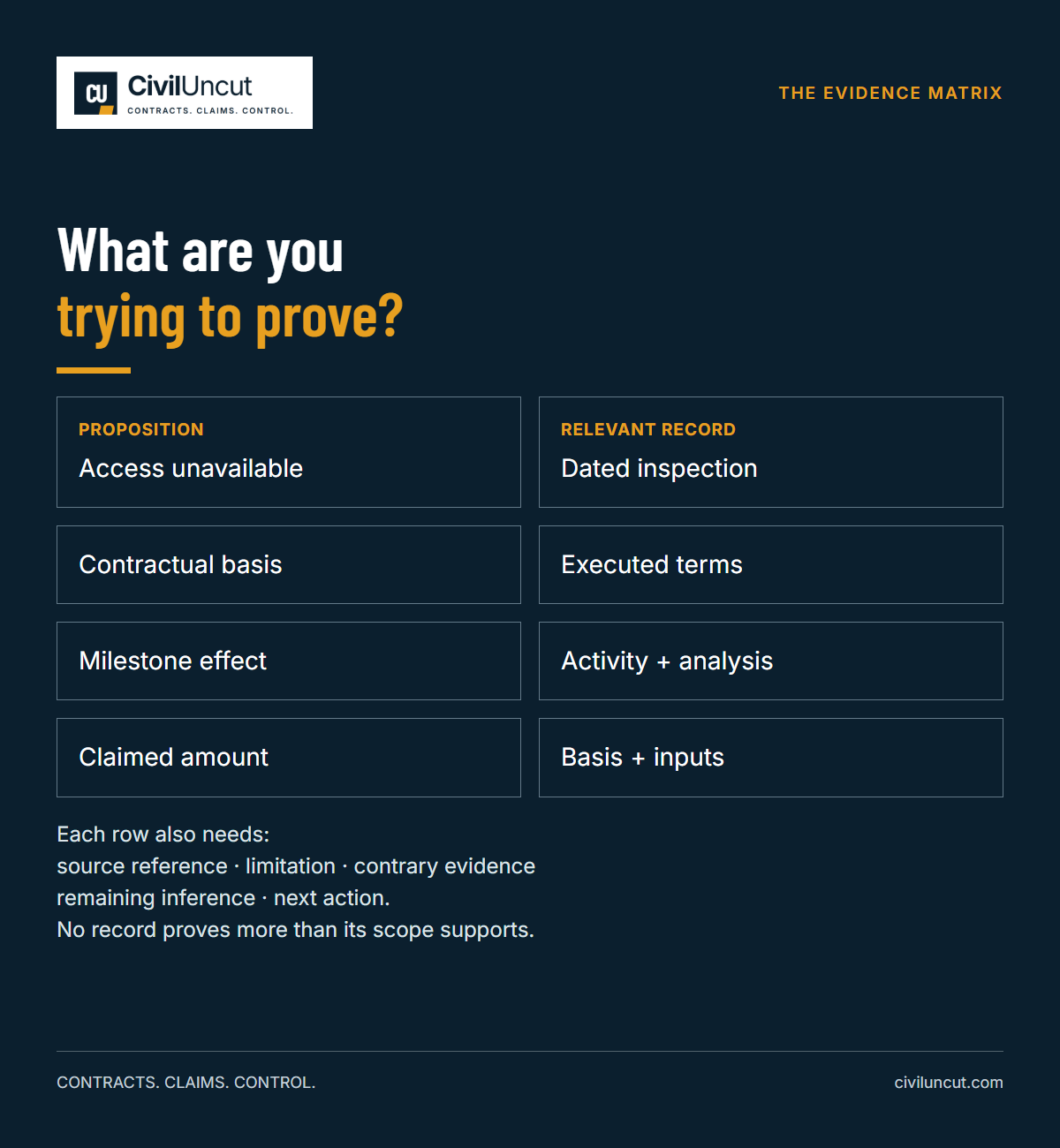
Use one row per material proposition. Record the event ID, proposition, contractual reference, source ID and exact page or entry, what that source supports, what it does not support, contrary evidence, remaining inference, calculation reference and next action. Add an owner and review date for each unresolved gap.
For the ROW example, a row might assert unavailability at one pier. Its sources are the inspection entries and dated photographs. A separate row asserts impact on the milestone, supported by activity records and a named programme analysis. Keeping these rows separate exposes the point where observation becomes inference.
Maintain a document index alongside the matrix. The index answers “where is the file?” The matrix answers “why is it relevant?” Give documents stable identifiers and keep revision history. Avoid renumbering annexures without updating the references in the narrative and calculation.
Use qualitative working labels such as supported, disputed, incomplete and requires analysis. These describe the review state, not legal sufficiency. An adverse record can narrow a claim, require a different explanation or reveal that a proposition should be withdrawn. Record that decision openly in the working review.
Submit an Argument Someone Can Check
Lead with the relief sought and its basis. Then give the event chronology, compliance account, affected work, causal explanation and calculation. Place references where the propositions are made. Distinguish agreed facts from disputed positions and identify assumptions that materially change the result.
For continuing events, identify the assessment cut-off and what will be updated under the applicable procedure. Reconcile the current submission with previous particulars and claimed amounts. Keep notice administration connected to the evidence file; the contractual notice guide explains that separate obligation.
Before issue, ask: can the reviewer find every cited source? Does it support the stated proposition? Is the contractual basis identified? Are time and money separately explained? Have overlaps, mitigation, adverse records and double counting been addressed? Are gaps visible and assigned? Does the requested relief follow from the analysis rather than from the size of the annexure?
The objective is not an impressive bundle. It is a position whose facts, contractual reasoning and calculation can be examined—and improved where the chain is incomplete.
Technical Note
This is a practitioner review framework, not a legal opinion, prescribed claim form or assessment of evidentiary admissibility. Contract editions, amendments, risk allocation, procedures and valuation mechanisms differ. Obtain appropriate professional review for disputed notice consequences, concurrency, legal remedies and complex delay or productivity analysis. Examples are fictional; no entitlement outcome is promised.