Career / CU-CONT-007 / V1.0
What a Contracts Engineer Actually Needs to Know on an Infrastructure Project
A useful contracts engineer can connect a site event to the obligation, records, programme, money and decision behind it.
An obstruction appears at a culvert. The site team photographs it. The planner moves an activity. Billing keeps the affected quantity outside the current bill. A letter says that work is delayed. Each department has done something, but the contractual position may still be unclear. Who was responsible for that obstruction? What procedure applies? Which completion obligation is affected? What can the available records actually establish?
These are the connections a contracts engineer needs to make. Clear writing matters, but a well-written letter cannot supply a missing fact or repair an unsupported calculation. Reading a clause matters, but quoting it does not show how it operates on this project. Competence becomes visible when someone turns incomplete information into a reasoned position and a practical next action.
This guide proposes a development framework for infrastructure work, including Indian projects. Responsibilities vary between contractors, consultants and employers, and with the contract and delegated authority. It is not a universal job description. A contracts engineer should understand the interfaces described here while recognising when planning, commercial, technical or legal specialists must lead the assessment.
The Competency Stack: Follow the Connections
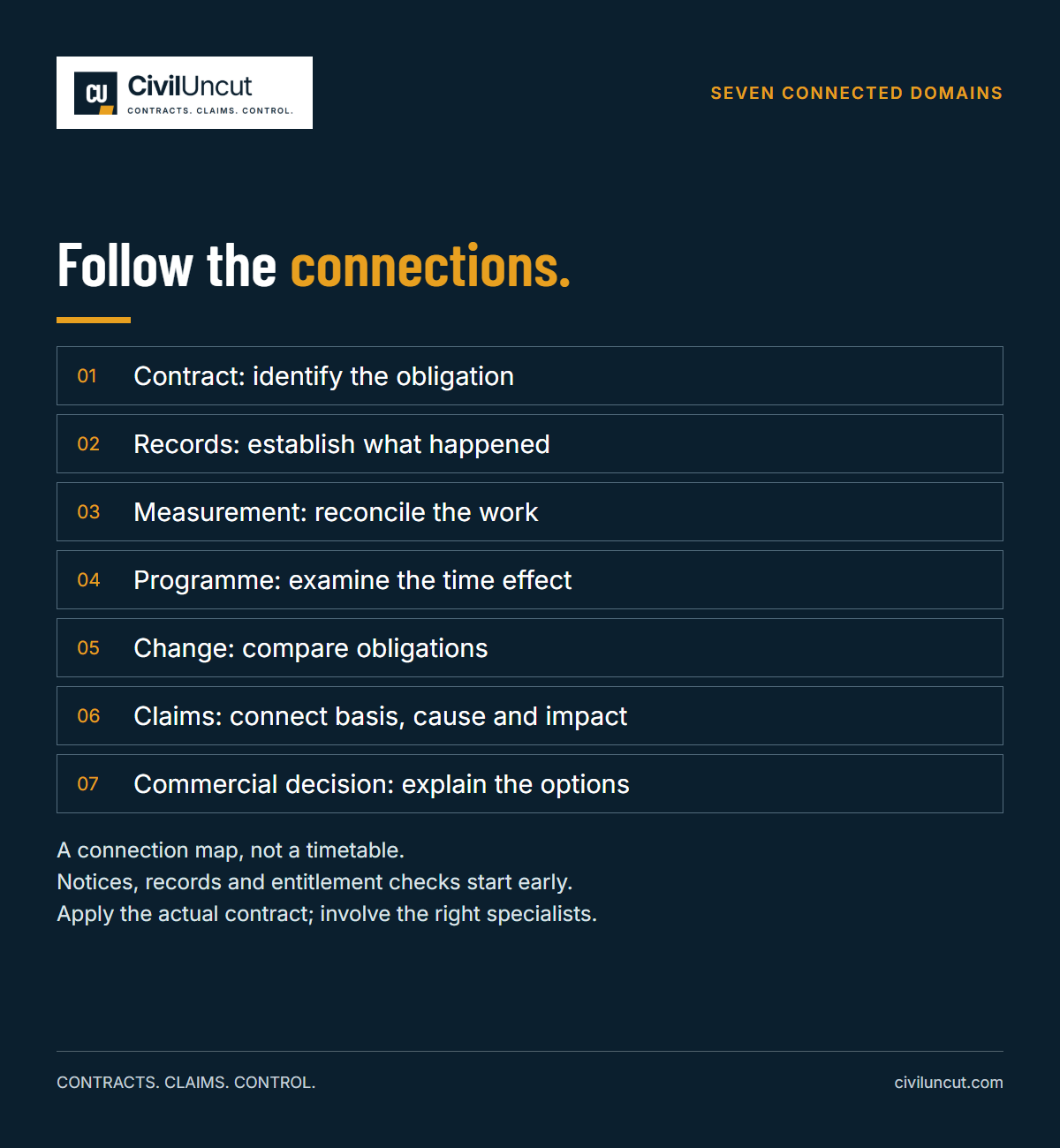
Use this chain to examine your work: contract → site facts → records → programme → measurement → commercial position → correspondence → entitlement → substantiation → management decision. At each connection, ask what supports the next statement. A record of an event does not itself prove responsibility. A responsibility argument does not establish the number of days or rupees recoverable.
This is a connection map, not a timetable. Screen entitlement and authority at the start. Give required notices while facts and impacts are still developing. Preserve records immediately. Return to the analysis as evidence changes. Waiting until the whole chain is complete before communicating could leave an urgent contractual obligation unattended.
The seven-domain graphic groups that work for quick recall. The ten domains below unpack it. The breadth is consistent with recognised professional guidance: the RICS quantity surveying and construction pathway includes contract administration, commercial management, planning and quantification. Its qualification requirements are separate from the practical CivilUncut model used here.
1. Read the Contract for Project Consequences
Start with the executed document set, including amendments, schedules and appendices. Identify scope, definitions, obligations and risk allocation before selecting a remedy. Then locate notice, variation, payment, time, claim and dispute provisions. Check the contract's document-priority rules when documents differ. A familiar standard-form clause may have been amended, supplemented or displaced in the agreement you are administering.
A useful exercise is an obligation sheet for one workfront: what must happen, who must act, what starts the obligation, what evidence records performance, and what follows if it is not performed. Reference the actual documents. Separate a stated obligation from your interpretation and from a question that needs clarification. Reading a clause becomes useful when you can explain its consequence to the project team.
For example, the historical NHAI NH-31D EPC document treats time extension, change of scope, the Authority's Engineer and stage payments in separate provisions. Its article18 also addresses approval limits. This illustrates why the word “Engineer” cannot settle authority by itself. It is a project-specific public reference, not a substitute for today's executed contract.
2. Make Correspondence Perform a Defined Job
Before drafting, identify the trigger, required recipient, timing, form, service route and purpose. Establish the occurrence and awareness dates where relevant. Decide whether the document records facts, requests an instruction, gives notice, submits particulars or responds to an assessment. One communication may perform several functions, but its distribution list and subject line alone do not establish compliance.
Write enough factual detail to identify the event and affected work. State the position accurately, reserve relevant rights where appropriate, retain delivery evidence and schedule the follow-up. Do not invent a finished impact assessment just because a notice is due. Conversely, do not assume a generic reservation cures a procedural omission. Escalate uncertainty about late notice or legal effect promptly.
Letter writing is one output of contract administration. The fuller task includes detecting events, obtaining reliable information, checking procedure, arranging authorised issue and tracking responses. Practise this distinction with A Notice Is Not Just a Letter. A good correspondence register should show what must happen next, not merely count what was sent.
3. Build Records That Answer Questions
Learn what daily reports, photographs, instructions, measurements, approvals, correspondence, programme updates and cost records can each establish. Record dates, locations, activities, authors and revisions. A photograph may show an obstruction without proving its duration. A machine log may record presence without demonstrating why equipment was idle. Ask what additional record would connect the observation to the proposition being advanced.
Keep original records identifiable and preserve contrary evidence. Label later reconstructions and their sources. When a gap appears, assign someone to investigate it while the people and physical conditions are still available. Do not backdate a reconstruction to make a file look complete. The practical test is whether another reviewer can reproduce the reasoning from the referenced material.
Use Daily Site Records Are Not Admin to examine capture at the workfront. A contracts engineer also needs retrieval discipline: event IDs, revision control and links between records. Hundreds of files are useful only if the team can locate the relevant evidence and explain its limits without relying on the memory of one individual.
4. Understand Measurement and Billing
Read the payment basis before checking the arithmetic. A BOQ item, a defined payment stage and a reimbursable cost have different supporting requirements. Establish the applicable item or stage, units, location, drawing revision, cut-off and evidence. In an EPC arrangement, a measured quantity increase does not automatically increase the contract price or satisfy a payment milestone.
Reconcile previous, current and cumulative figures on a consistent basis. Identify corrections separately from newly executed work. Check whether quantities have already been included elsewhere and whether the claimed rate or valuation basis is established. A spreadsheet can balance perfectly while combining different revisions, repeating a quantity or pricing work under the wrong provision.
Track submitted, assessed, certified and paid amounts separately. Understand disputed deductions, recoveries and outstanding evidence without treating every difference as an admitted debt. Work with billing staff to explain the movement between stages. The RA bill review framework develops this interface: measured work is not automatically payable work, and certification does not mean cash has been received.
5. Establish What Actually Changed
For a proposed variation, put the original obligation beside the changed obligation. Locate the instruction or event, check authority and identify the procedure. Distinguish a revised requirement from design development, correction of defective work or work already within the contractor's obligations. The absence of a convenient BOQ item does not, by itself, establish a payable change.
Keep execution, entitlement, valuation and time status separately visible. The site may have executed work while the rate remains disputed. An authorised scope change may require a separate time assessment. Preserve contemporary quantities and resources while seeking clarification; do not represent unresolved matters as approved. Decisions about proceeding under disputed or oral directions require the actual contract and appropriate escalation.
The useful skill is assembling a comparison that another person can test. Ask which document establishes each obligation and which record establishes the change. A Variation Is Not Just Extra Work provides the detailed framework. A confident description of “extra work” is less useful than a traceable explanation of what changed and why it matters.
6. Connect Delay to the Completion Obligation
An event register is the beginning of an EOT assessment. Identify the contractual basis, notice position, affected activity, relevant programme and completion obligation. Work through the causal link: what was prevented, for how long, what work could proceed, and how did the effect reach the relevant milestone? A delayed activity may have float or may no longer control completion.
Discuss critical-path movement, mitigation and other causes with the planner. Distinguish a local stoppage from delay to completion and assess overlapping events rather than simply adding durations. Concurrency treatment and entitlement depend on the facts, wording and applicable law; a contracts engineer should identify the issue without pretending that two overlapping date ranges settle it.
Time and cost need related but distinct assessments. Do not convert an EOT request into an automatic prolongation-cost claim. Record what remains provisional and what evidence is still needed. A Delay Does Not Automatically Give You EOT is the starting point for testing that distinction. A calendar total becomes useful only when its causal and contractual basis can be explained.
7. Structure a Substantiated Claim
A claim position needs an identifiable contractual basis, facts, causation, impact, quantification and supporting evidence. Build a chronology, then map each important proposition to a source. Explain assumptions and gaps. Keep the narrative aligned with the calculation: a claim described as idle plant should not quietly include resources that were productively deployed elsewhere during the same period.
Test alternative explanations and adverse records before submission. Separate agreed facts from disputed facts, and the amount asserted from the amount supported by the current assessment. Use cross-references that allow a reviewer to move from a statement to a document and back to the calculation. A large appendix should serve the argument rather than conceal weaknesses in it.
The ability to assemble this structure is useful before a dispute develops. It improves ordinary change discussions and management decisions too. A Claim Is Only as Strong as Its Evidence explains the substantiation chain. Know when the issue calls for specialist delay, quantum or legal advice, and prepare the factual record so that advice can be effective.
8. Work Productively with the Planner
Understand the baseline, update dates, activity logic, calendars, progress measurement, remaining durations and schedule narratives. Ask which programme version was used and why. Retain the contemporary update and its explanation rather than relying solely on a later presentation. A coloured bar chart may communicate a result while hiding the assumptions that produced it.
The APM competence framework treats integrated planning, schedule management, contract management and change control as connected areas of practice. For a contracts engineer, the practical objective is an informed interface. Ask the planner to demonstrate the event-to-activity-to-milestone connection, then check that the contractual account uses the same facts and dates.
You do not need to replace the planner. You do need to recognise an unexplained logic change, inconsistent progress date or unsupported duration assumption and request clarification. Record the answer. Planning and contracts staff should leave a review with a shared account of what the analysis demonstrates, what it assumes and what it cannot yet establish.
9. Understand the Commercial Consequence
Work with the QS and commercial team on rates, BOQ coverage, resource records, productivity, subcontract positions and recoveries. Distinguish cost incurred, forecast cost, contract valuation and potential recovery. They answer different questions. A subcontractor invoice may help establish expenditure, but it does not independently establish the employer's liability for the same amount.
Ask whether costs relate to the identified event and period, whether resources were reassigned, and whether amounts overlap with another valuation or claim. Keep the basis of any productivity comparison visible. Understand how outstanding certification, payment timing and disputed positions affect cash flow. This is commercial awareness for project decisions, not a request to become the project accountant.
RICS commercial-management guidance connects commercial decisions with reliable information and analysis. Its UK context should not be imported as Indian payment law. Use the general discipline: show the evidence behind an exposure figure, its assumptions and its status before management relies on it.
10. Give Management a Decision It Can Make
A useful event summary identifies the event, contractual position, notice status, possible time and cost exposure, evidence gaps, next action and decision required. Distinguish a working estimate from an assessed entitlement. Name the owner and date for the next action. If the answer is uncertain, identify what would reduce that uncertainty rather than hiding it behind broad wording.
For a blocked workfront, management may need to choose between resequencing, obtaining further direction or escalating a delayed decision. Explain the assumptions and records needed for each option. Keep operational action and contractual assessment coordinated. A contracts engineer's report should help an authorised person decide, while making clear which conclusions still require review.
Three Levels: Identify, Apply, Advise
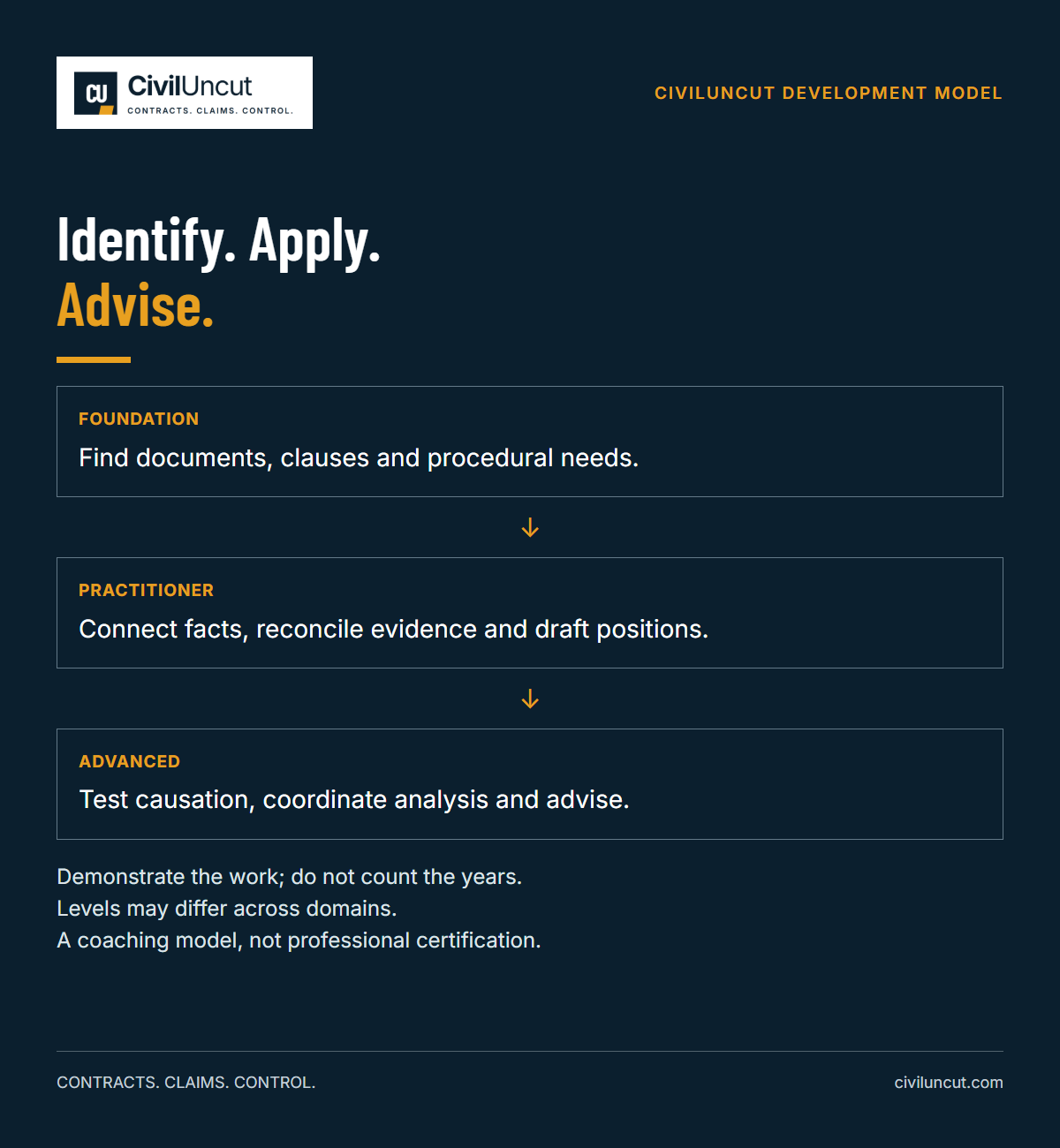
Foundation means being able to find relevant documents, recognise a potential issue, identify clauses and records, and flag procedural requirements for review. Useful evidence might be an accurate obligation sheet and event chronology. Someone at this level should be able to say what they do not yet know and obtain help before an urgent action is missed.
Practitioner means analysing the event, connecting facts to the contract, identifying gaps, drafting structured correspondence and reconciling evidence. The output should support a commercial decision and survive questions about its sources. Recognising that the current record does not support a proposed conclusion is part of this competence, not a failure to be assertive.
Advanced means evaluating causation and alternatives, developing strategy, coordinating planning and commercial evidence, structuring claims or change positions, advising leadership and reviewing junior work. Advice stays within professional competence and delegated authority. These are CivilUncut coaching categories, not professional certification or equivalents of an institution's levels. Years of experience alone do not establish any of them; a person may demonstrate different levels across domains.
Five Fictional Workfront Tests
1 — An obstruction, but no notice. A junior notices that a utility trench blocks culvert excavation and finds dated photographs. A practitioner asks when it became known, who carries the relevant obligation, what communication was issued, which notice route applies and what activity was affected. An advanced reviewer evaluates the procedural risk, remaining actions, mitigation options and possible programme consequence, obtaining legal review where needed. The photographs establish neither notice compliance nor automatic EOT.
2 — A planner reports twenty days of delay. A junior sees that a foundation activity finished late. A practitioner asks which update, logic and progress records explain the movement and whether the activity controlled the relevant milestone. An advanced reviewer tests competing causes, changing criticality and mitigation, then coordinates the contractual and planning narratives. Twenty days on one activity must not silently become twenty days of excusable completion delay.
3 — Extra drainage work is already executed. A junior records quantities and the site direction. A practitioner compares the original drainage obligation with the revision, checks the issuer's authority and traces procedure and valuation status. An advanced reviewer evaluates design responsibility, the competing scope interpretation, further direction needed and time implications. The response should preserve an accurate record of completed work without presenting a disputed instruction as an approved variation.
4 — The RA bill adds up. A junior confirms the culvert quantities total correctly. A practitioner checks drawing revisions, location-specific measurements, previous certification, current additions and applicable payment basis. An advanced reviewer evaluates unsupported or duplicated amounts, unresolved valuation and the consequence for certification and cash flow. The right outcome may be a targeted request for evidence rather than either wholesale acceptance or rejection of the bill.
5 — The claim folder contains hundreds of files. A junior produces an index. A practitioner maps the documents to responsibility, causation, time and quantum, identifying missing links. An advanced reviewer challenges the proposed position against adverse evidence and alternative explanations, then decides what further analysis or advice is needed. A tidy folder is useful preparation; a substantiated position explains what the documents collectively prove and where they fall short.
A Practical Development Path
One useful sequence is site execution → documentation → billing and measurement → contract reading → notices and change → programme interface → EOT and claims → commercial strategy. It is not the only route. A planning engineer may enter through programme analysis; a QS may enter through valuation. Use your existing strength, then deliberately practise the interfaces you understand least.
Choose a fictional exercise or an appropriately authorised, non-confidential work sample. Prepare a short chronology, obligation comparison and evidence map. Ask a reviewer to identify the weakest connection. Revise the work and retain a note of what changed in your reasoning. Progress is demonstrated by better analysis and more reliable decisions, not by producing a larger bundle of documents.
Excel helps with reconciliation when formulas, units and sources are controlled. Scheduling-software awareness helps you question an update without claiming to be a delay expert. Document control, concise writing, presentation and data analysis make your reasoning easier to review. BIM awareness can help where model revisions inform scope or quantity, but model information still needs its contractual status checked.
The proposed CU-ASSESS-001 Practical Competency Map would use fictional exercises and qualitative feedback across these domains. It is a design concept, not an available assessment, an employability score or a certification. For now, take one event and demonstrate the connections: what happened, which obligation matters, what supports the position, what remains uncertain and what decision the project needs next.