Billing / CU-CONT-006 / V1.0
An RA Bill Is Not Just a Quantity Check: A Practical Review Framework for Infrastructure Projects
A defensible running account bill connects the work claimed to its contractual payment basis, supporting records and previous account before asking for certification.
The multiplication is correct. The quantities add up. The covering letter and attachments are ready. Yet the bill includes an obsolete drawing quantity, a repeated previous quantity and a changed item whose rate remains unresolved.
None of those problems is solved by checking the spreadsheet total again. An RA bill can be mathematically correct and commercially wrong. The review must answer a more demanding question: what supports this amount becoming due under this contract, in this bill?
For the contractor, that means preparing a submission the reviewer can follow. For the Engineer, QS or Authority's Engineer, it means recording the basis of assessment and exceptions. For accounts, it means reconciling the resulting certificate with deductions and actual payment. These are connected responsibilities, not interchangeable signatures.
First Identify the Payment Model
RA means running account in this article. Projects may use interim-payment applications, stage-payment statements or other contractual names. Start with the mechanism, not the heading printed on the form. Identify the agreement, amendments, payment schedule, measurement method and bill cut-off date.
In an item-rate arrangement, measurement and the applicable item rate may drive the valuation. In an EPC arrangement, defined stages and their allocated values may govern interim payment. Quantity calculations can support stage completion without independently creating a right to payment for every measured unit.
For example, the historical NHAI NH-31D EPC tender, clauses 19.3–19.4, links interim claims to completed stages valued through Schedule H. That example is not a universal rule for current highway contracts. It demonstrates why a BOQ-style worksheet cannot automatically replace the contractual stage-payment test.
Create a short payment-basis note before reviewing the first bill. Record which provisions control ordinary work, changed work, advances, adjustments and certification. Keep it updated when the contract is amended. Do not let an inherited spreadsheet silently decide the payment model.
The CivilUncut RA Bill Review Chain
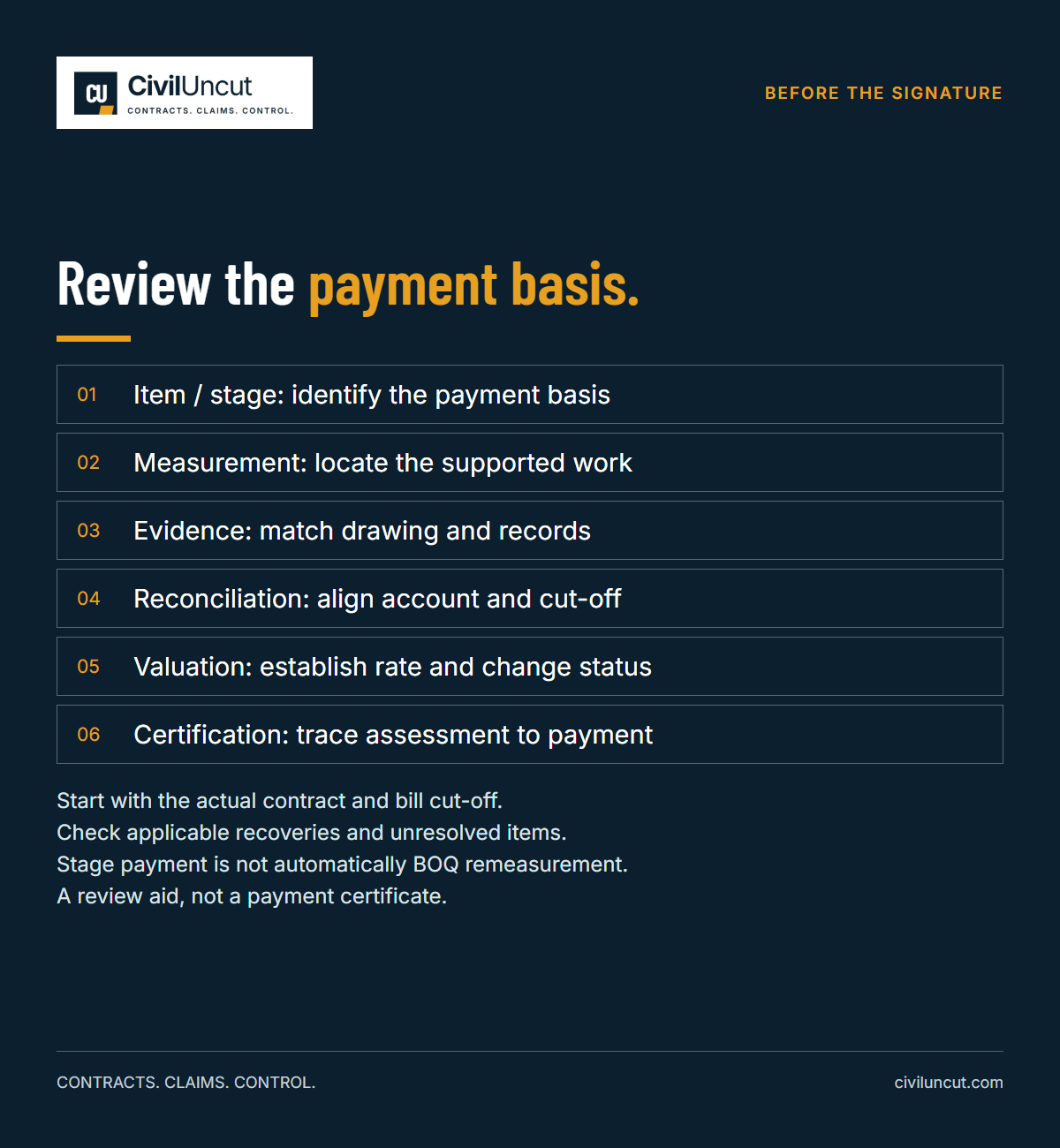
Use this sequence after identifying the payment model and cut-off: contract item → executed work → measurement → drawing/specification → supporting record → previous quantity → current quantity → cumulative quantity → rate/valuation basis → variation/COS status → deductions/recoveries → certification/payment trail.
For a stage-payment contract, read “item” as the applicable payment item or stage and test the defined completion criteria. Do not force a physical-quantity formula onto every payment line. Keep measurement evidence and contractual eligibility visible as separate checks.
The chain is a review aid, not a prescribed contractual form. Queries can return the team to an earlier step. A revision discovered during rate review may require a new quantity check. A previously certified discrepancy may require a transparent correction rather than an unexplained adjustment to current work.
Map the Work Before Measuring the Amount
Give each claimed line an identifiable location: chainage, structure, level, pier, bay or workfront. Connect it to the contract item description and unit, or the relevant stage. Check inclusions as well as exclusions. Similar item names can conceal different material grades, depths, leads, finishes or associated operations.
A missing BOQ line does not automatically establish a variation. The activity may already sit within a composite item, an inclusive rate or an EPC scope obligation. Conversely, an existing BOQ description does not settle whether a separately instructed change has occurred. Read the scope and valuation provisions before choosing the billing treatment.
Where work is performed by a subcontractor, reconcile the head-contract basis separately. A subcontractor's accepted quantity or rate may follow different terms. Its bill is a useful source for investigation, not automatic proof of the amount recoverable from the Employer. Watch interfaces where two subcontract packages claim the same physical work.
Test the Measurement Basis and Source
Identify the applicable method of measurement and the records required by the contract or adopted procedure. Check units, dimensions, reference levels, location boundaries, deductions and the basis of any conversion. Do not mix loose, excavated and compacted earthwork volumes without an authorised basis that fits the item being valued.
Trace the abstract quantity to measurement-book entries, joint sheets, survey records or the applicable digital measurement record. Identify the measurement date, preparer, checker and any agreement or reservation. A joint record should make clear whether the parties agreed dimensions, calculation, classification or a broader commercial position.
The historical CPWD Works Manual available on its official site, with a December 2007 foreword, links measurement records to works accounts and bill carry-forward in sections 7.1–7.2 and 7.12.4. It is a historical illustration of traceability, not a statement of today's procedure for every public project.
Where work will be covered, the evidence problem should be addressed before access disappears under the applicable inspection and measurement procedure. A photograph may assist, but it may not establish the required dimensions or acceptance conditions. The daily site records guide explains the underlying capture task.
Match Drawings, Specifications and Acceptance Records
Identify the drawing revision governing the work at the relevant time, its issue purpose and its required approval or review status. “Latest drawing” is not enough if part of the quantity was executed under an earlier instruction. Preserve the revision history and distinguish original work, changed work and corrective work.
Match specifications, inspection requests and test records to the claimed location or batch where they are relevant to payment. A passing test from another pour does not resolve this pour's record gap. A material invoice supports a purchase or supply transaction; it does not by itself establish the installed quantity or completion of a payment stage.
Do not turn a document checklist into indiscriminate attachment collection. Identify which record supports which item or condition. Mark a missing record precisely and assign an action. “Documents incomplete” is much less useful than identifying the affected line, required evidence, responsible person and review date.
Reconcile Previous, Current and Cumulative

For a consistent quantity account without corrections, previous cumulative quantity + current addition = current cumulative quantity. Compare that result with the supported executed quantity on the same item, location, unit and cut-off basis. Arithmetic agreement is necessary for that account; it is not proof that the underlying measurement is correct.
Label the columns carefully. Previous submitted, previous measured, previous certified and previous paid are different states. Do not subtract a submitted quantity from a certified cumulative quantity and describe the result as current execution. Payment itself is usually an amount, not a new measurement of physical work.
Use a visible correction column when needed. In a fictional account, previous cumulative quantity is 1,000 cubic metres, newly supported work is 200, and an identified earlier overstatement is corrected by minus 50. Revised cumulative quantity is 1,150. The net movement is 150; the newly executed quantity remains 200. These are different answers to different questions.
Keep the original certificate and correction reference. Do not overwrite the previous figure to make the worksheet look clean. Explain who authorised or determined the adjustment under the applicable procedure. Previous certification is not a substitute for current reconciliation. Whether and how a certificate can be corrected depends on the contract.
The FIDIC MDB Harmonised Conditions, March 2006, clauses 12 and 14, distinguish measurement, evaluation, certification and payment; clause 14.6 provides for corrections to earlier certificates. This is a specific historical form, not a rule automatically imported into another contract.
Establish the Rate and Change Status Separately
For each line, identify the valuation route: contract rate, applicable similar rate, derived or new rate, agreed change value, provisional assessment where permitted, or defined stage allocation. State its document reference and status. A contractor's proposed rate is not an agreed rate simply because it appears in several bills.
Check whether the relevant rate includes operations or materials being claimed elsewhere. Review quantity deviations against the actual contractual provisions; exceeding the BOQ quantity does not by itself justify a new rate. Do not borrow a threshold, escalation formula or market-rate method from another project.
For changed work, separate the original obligation, instruction, authority, change recognition and valuation status. “Variation identified” and “valuation agreed” are different entries. Link the line to the change register without treating the register as the authorising document. The variation guide addresses that substantive inquiry.
If a rate or entitlement remains disputed, identify the amount sought, the assessed position and the contractual route for interim treatment. Do not assume either that everything must wait for final agreement or that every proposed amount must be certified. Preserve the applicable notice and correspondence trail.
Review Advances, Deductions and Recoveries
Materials delivered to site are not automatically eligible for an advance or interim materials payment. Check the applicable provision, material identity, eligible use, inspection, storage and any required security or supporting invoices. Reconcile opening stock, receipts, incorporation, returns and closing stock on a consistent basis.
Where an advance was paid against materials later incorporated in measured work, review the required recovery so the same value is not counted twice. Keep material advances distinct from mobilisation advances and from ordinary stage payments. Their conditions and recovery mechanisms may differ.
For each deduction or recovery, record its contractual or verified statutory basis, calculation base, current amount and cumulative balance. Review retention separately from other security arrangements, including any limits and release conditions that actually apply. Check previous recoveries before repeating them. A percentage copied from the last project is not a defensible basis.
The Department of Expenditure Works Manual, second edition 2025, sections 7.5.2 and 7.6.3–7.6.5, illustrates that interim review and reconciliation extend beyond quantities. Its scope and later amendments need checking. This article supplies no tax rates, retention percentages or universal payment deadlines; obtain the applicable project and statutory advice.
Five Fictional Review Situations
The following examples are deliberately non-confidential. Their quantities and conditions are invented to expose review questions, not to prescribe entitlement outcomes. Apply the actual contract when deciding certification, correction or disputed treatment.
1. Earthwork Exceeds the Supported Survey
An embankment bill claims 12,400 cubic metres. The multiplication by the selected rate is correct, and the work is visibly substantial. However, the available cross-sections support only 11,900 cubic metres on the stated basis; the remaining area has been estimated from an unreferenced sketch.
The missing support is the relevant original and final levels, section boundaries, calculation and any required joint verification. This is primarily a measurement issue, with a contractual question about the applicable measurement method. Truck counts cannot silently replace the specified in-place basis.
Before submission, separate the unsupported portion and reconcile or obtain the missing measurement evidence. Before certification, record the assessment and the treatment permitted by the contract. Neither an arbitrary deduction nor a blanket acceptance answers the gap. Physical presence alone does not establish the billable quantity.
2. RCC Quantity Uses the Wrong Revision
A bridge-pier concrete calculation is arithmetically correct for Revision C. The pour records identify work performed under Revision B, while a later instruction changed the pedestal. The bill applies Revision C to the whole structure without distinguishing when or where the change was executed.
The required support is the drawing issue trail, instruction, pour-location records, measurements and relevant inspection or test references. The issue spans measurement, scope and valuation. A drawing approval does not automatically settle commercial treatment of every difference.
Split the quantity into supported original work and the identified changed portion, then review the applicable change basis. Resolve the revision mismatch before presenting the whole quantity as an undisputed bill line. Certification should identify its actual basis and any remaining exception; it should not conceal the uncertainty inside a single total.
3. The Carry-Forward Does Not Reconcile
An urban-drainage bill shows 800 metres previously certified, 150 metres current and 1,000 metres cumulative. The rate is correct. The current measurement sheets support 150 metres, but the cumulative total includes another 50 metres carried from a contractor's earlier submission that was not certified.
The missing control is reconciliation between the prior submission, certificate and current location register. This is an account and certification-status issue, not necessarily a new measurement problem. The unexplained 50 metres must not acquire certified status through a spreadsheet carry-forward.
Identify whether that portion is now supported and eligible, still disputed or simply duplicated. If it is legitimately resubmitted, show it separately with its earlier reference and current basis. Reconcile the chosen account so previous plus current matches cumulative without silently mixing submitted and certified figures.
4. Changed Work Is Executed but COS Is Unresolved
A highway team has completed an additional drainage arrangement. Joint sheets support its dimensions, and the bill describes it as approved COS. The file contains a site instruction but no clear record establishing the issuer's authority or the commercial status claimed in the bill.
The missing support is the original scope comparison, instruction and authority trail, required change procedure and valuation position. This is principally a contract and valuation issue; repeating the measurement exercise will not resolve it.
Correct the status description before submission. Present the factual record, proposed basis and unresolved decision to the competent reviewer. Determine the permitted interim treatment, separating any undisputed elements where the contract allows. Measured work should remain visible, but “executed” should not be relabelled “approved and agreed” without support.
5. A Non-BOQ Item Has No Established Rate
A rail-interface duct arrangement has been installed and its length jointly recorded. The bill uses a supplier quotation plus an unexplained uplift. The team assumes that absence of a matching BOQ line makes this a payable extra at the proposed rate.
First check whether the obligation is already included in another item or the contracted scope. If a separately valued change is established, identify the actual valuation mechanism and supporting build-up. Relevant evidence may include instruction records, comparable items, resource assumptions and quotations, depending on that mechanism.
This is an entitlement and valuation issue rather than an arithmetic error. Before submission or certification, distinguish proposed, assessed and agreed rates and document the permitted interim position. A supplier quotation may inform a calculation; it does not itself create the contract rate.
Close the Certification and Payment Trail
Maintain a bill-level record of submission number, period, revision, amount applied for, amount certified, deductions, net amount due under the certificate and actual receipts. Record certificate and payment dates separately. A certificate establishes an assessed position under its terms; it is not proof that the money reached the contractor.
Reconcile bank receipts with payment advice and the accounts ledger, including partial payments and explained adjustments. Do not describe a withheld amount, a disputed quantity, an unpaid certified amount and a retention balance as one undifferentiated “pending” figure. Each needs a different follow-up.
Use an exception log for unresolved lines: item, location, issue category, amount or quantity affected, source reference, reviewer position, next action and owner. Apply the contract's certification powers and payment obligations; the log does not create a right to withhold an entire bill. Supporting evidence should make the position reviewable, as explained in the claim substantiation guide.
The Review Before the Signature
Ask whether the payment model and cut-off are clear; each item or stage is correctly mapped; measurements are traceable; drawings and evidence match execution; previous, current and cumulative accounts reconcile; corrections are visible; valuation and change status are accurate; deductions have a basis; and certification can be followed through to payment.
A checklist can organise this review. A quantity sheet can expose mismatches. A bill tracker can show commercial follow-up. None substitutes for the others, and a larger attachment folder does not establish reconciliation. The useful outcome is a bill whose assessed amount can be explained line by line.
Technical Note
This is a practitioner review framework, not a payment certificate, tax opinion or legal determination. Contract forms, amendments, measurement methods, certification powers and statutory requirements differ. Historical public sources illustrate distinctions rather than universal rules. Seek project-specific professional review for disputed payment, deductions, changes and remedies. All scenarios are fictional; no confidential project information is used.